Explore Beijing / Tap to Pay in Beijing: Contactless Cards, Phone Wallets and Metro Gates
Tap to Pay in Beijing: Contactless Cards, Phone Wallets and Metro Gates
Where a contactless tap actually works in Beijing — every metro gate now takes Visa, Mastercard, JCB, Amex and UnionPay — where only QR codes work, what it costs, and why you still need cash.
11 min read · KOULING's Beijing Travel Guide
If you have not carried a physical card in years, Beijing will test the habit. Here is the short version: your contactless card or phone wallet works brilliantly at Beijing metro gates — the city became the first metro network in the world to accept all five major card organisations at every gate — and it works at international hotels, big malls and airport shops. It mostly does not work at the noodle shop, the taxi, the wet market or the corner convenience store, where the only thing on offer is a QR code inside Alipay or WeChat Pay. This guide is about exactly where a tap gets you through, where it gets you a blank look, and the rules that actually govern each case.
The one-line answer
Beijing's own playbook for foreign visitors is 大额刷卡、小额扫码、现金兜底 — cards for large amounts, QR codes for small ones, cash as the backstop. A contactless tap is simply a card payment in disguise, so it follows the card rule: it belongs to the big-ticket, card-acquiring layer of the city, and it is not a substitute for a QR wallet. Give yourself three layers before you land. Layer one is a contactless card or phone wallet, for hotels, department stores, airport shops and the metro. Layer two is Alipay or WeChat Pay with a foreign card linked, for everything under about ¥200. Layer three is ¥300–500 in notes, for the moments when neither of the first two is available. One layer will fail you during a trip; two rarely do; three almost never.
Where a tap actually works
These are the places where a contactless terminal exists, is switched on, and is configured for international cards.
Beijing Subway gates — every line, every station — the single biggest win, see below
Hotels rated three stars and above — a State Council directive requires tourist hotels at three stars and above to accept both domestic and overseas bank cards [verify]
4A- and 5A-rated attractions — the same directive requires card acceptance at national 4A/5A scenic areas, national and provincial resorts, and national tourism and leisure districts, and asks them to keep manned ticket booths [verify]
Both airports — Capital and Daxing each run foreign-card-ready merchant zones, ATMs that dispense small notes, and 24-hour manual currency exchange in both arrivals and departures
International retail in malls — department stores, global fashion chains, Apple's own stores and some Starbucks — look for the contactless wave symbol, not just a logo sticker
Major supermarket checkouts — large chains generally have card terminals with contactless readers at the till
Where a tap will get you nowhere
Most of everyday Beijing runs on QR codes, and no amount of tapping changes that. Street-food stalls, small family restaurants, wet markets, barbers, most taxis waiting at a rank, bubble-tea counters and convenience-store snacks are QR-only. These businesses do not have a card terminal at all — not a broken one, none at all — so there is nothing for your card to talk to. The rule of thumb that holds up: the bigger and more international the venue, the more likely a tap works; the smaller and more local, the more certain you need a QR code or cash. One more thing to settle before you fly — Google Pay and Google Wallet do not function in mainland China at all, because Google's services cannot be reached. If you are on Android and Google Wallet is your only wallet, treat yourself as having no wallet and install Alipay instead.
The Beijing metro: the best reason to still carry plastic
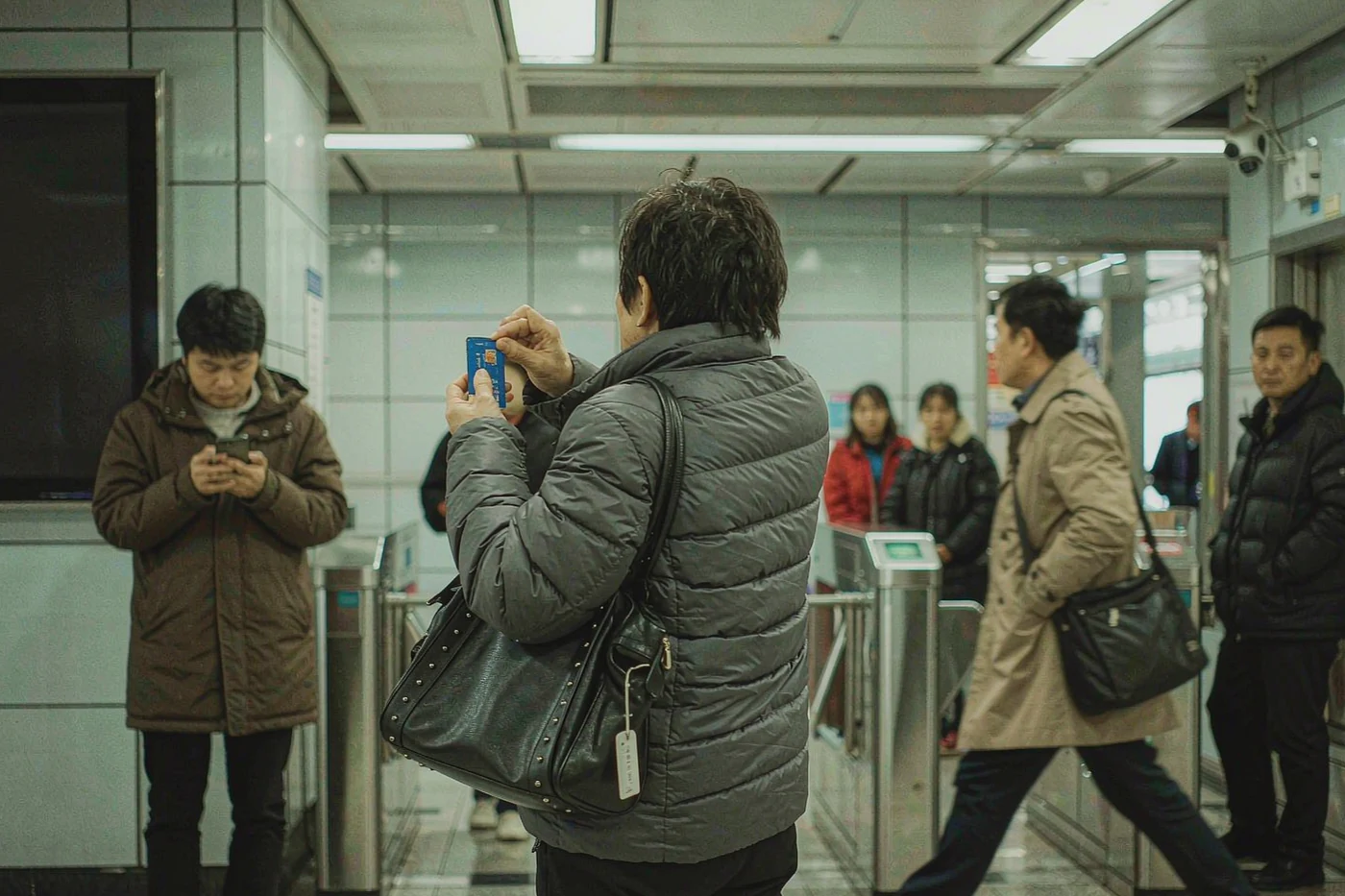
This is the part that surprises people who visited a few years ago. The Beijing municipal government announced in March 2026 that its urban rail network had become the first in the world with full-network coverage of all five major card organisations: China UnionPay, Mastercard, Visa, JCB and American Express. The coverage is described as 29 operating lines and 523 stations plus Suburban Line S2 [verify], and by September 2026 the People's Bank of China's Beijing branch reported more than 2.4 million foreign-card gate taps from users in over 150 countries and regions, with usage in the first eight months of 2026 roughly double the previous year [verify]. In practice it means this: no ticket, no transport app, no Chinese phone number, no real-name registration. Walk to a gate that shows your card's logo, hold the card flat against the marked reader, and walk through when the gate opens. If you only take one thing from this guide, take that.
Tapping in and out without getting stuck
The metro rules are written down in the 北京市城市轨道交通车票使用规则 (Beijing Urban Rail Transit Ticket Rules, revised August 2026), and the failure cases foreigners hit are almost all in this list.
One card, one person, one entry, one exit — 官方 wording is 一人一卡、一进一出 — you cannot swipe two people through on one card
Never mix the plastic card and the phone token — 实体卡与手机NFC卡不可在同一个行程混用: if you enter with the physical card you must exit with that same physical card, because the phone version counts as a different credential even for the same account
Using a phone wallet? Charge and NFC first — the rules require enough battery, NFC switched on, and the right card selected before you reach the gate — a flat phone at the exit gate is a genuine problem, not a hypothetical one
UnionPay QuickPass cards need headroom — under the 银联卡业务运作规章, a 银联闪付卡 or 手机闪付卡 must have available funds of at least the highest fare from your entry station plus the overtime fee, or the gate will not open
Always tap out — the fare is only charged after a matched exit, and an unmatched entry will block that card on your next trip until it is resolved at the service window
Airport express lines play by different rules — the Capital Airport Express and Daxing Airport Express are excluded from the standard fare rules and from the monthly discount ladder [verify] — check the fare board before you tap
What it costs, and the monthly discount ladder you probably did not know about
Metro fares are distance-based and start at ¥3 for a short hop [verify]. The genuinely useful detail is that a bank card earns the same monthly discount ladder as a local transit card, on ordinary rail lines (excluding the airport express lines). Once your spending on that one card passes ¥100 in a calendar month, every further ride is 20% off; past ¥150, it is 50% off; once cumulative spending reaches ¥400, discounts stop for the rest of that month. The counter resets at the end of each calendar month. Two consequences follow: put every ride on one card rather than spreading them around, and do not expect a two-week stay to reach the ¥100 threshold unless you are riding a lot. Separately, UnionPay International runs a metro offer for cards issued outside mainland China on the Beijing and Shanghai metros, valid to 31 December 2026 [verify]: tapping with UnionPay Mobile QuickPass — which includes Apple Pay and Huawei Pay — or with the physical UnionPay card takes 50% off, capped at about ¥2 per ride for most overseas-issued UnionPay credit cards and about ¥4 for SplendorPlus cards, with one discounted ride per card per day, ten per phase, on a first-come first-served daily quota. If you happen to hold a UnionPay card from home, check this before you fly.
Apple Pay, Google Pay and Samsung Pay: what is different
Three wallets, three different answers, and only one of them is worth setting up.
Apple Pay — it runs on the UnionPay contactless network in mainland China. Apple's own support page states that in mainland China some international Mastercard and Visa debit or credit cards can be added to the Wallet app from the issuer's own app and used for cross-border transactions, and tells you to check eligibility with your issuer [verify]. Useful at hotels and large retailers; useless at a QR-only counter
Google Pay and Google Wallet — they do not function in mainland China at all. This is not a card-network problem — the apps simply cannot connect. Do not build a plan around them
Samsung Pay — the same structural issue as Apple Pay: it leans on UnionPay and China-issued cards, so a foreign card buys you very little
Express Transit on the metro — you may see it mentioned for Beijing. Treat it as a nice-to-have rather than a plan; the reliable route in 2026 is tapping an open-loop bank card or phone wallet directly at the gate [verify]
What a tap costs you in fees
Nobody gets paid for free, and the split between card and QR is deliberately designed to push small payments away from cards.
Your bank's foreign transaction fee — commonly 1–3% on every transaction with a standard card, on top of any currency conversion margin [verify]
QR wallets are free for small amounts — Alipay and WeChat Pay charge foreign cards nothing on a payment of ¥200 or less, and roughly 3% on the whole amount once it goes above ¥200 [verify] — which is exactly why the local advice is cards for big, QR for small
Regulatory ceiling after ID verification — foreign-card spending through the wallet apps sits under a ceiling of about US$5,000 per transaction and US$50,000 a year once your passport has been verified [verify]
Always decline dynamic currency conversion — if a terminal offers to bill you in your home currency, say no and let the card network convert — the terminal's rate is consistently worse
Expect pre-authorisation holds — hotels routinely hold more than the final bill, and the hold can sit on your card for days after check-out
When the tap fails: the order to try things
Work down this list rather than tapping harder.
Is your network's logo on that gate or terminal? — a logo means the merchant has acquiring for that network; no logo usually means no, whatever the card looks like
Take the card out of your wallet — holding a wallet with three contactless cards against a reader gives it nothing to choose between, and many readers simply abort
Check you used the same credential in and out — at metro exits this is the single most common cause of my card stopped working
Phone died mid-journey? — go to the service window with your passport; you cannot complete the trip on a flat phone token
Still declined? — switch to Alipay or WeChat Pay, then to cash. This is what the ¥300–500 in your pocket is for
Who to call — 外卡 enquiries on the metro go to the Beijing rail network hotline 010-96123 (Chinese-language service); UnionPay card and phone QuickPass issues go to UnionPay on 95516. For a foreign-language question about a specific transaction, the ticket rules direct you to your own issuing bank
Need a receipt? — 外卡 rides can obtain an e-invoice 发票 through Beijing rail network customer service [verify] — worth asking if you are claiming expenses
Set this up before you fly
Almost every payment horror story in Beijing is a setup problem that was solvable at home, not a Beijing problem.
Two cards, two networks, two bags — one Visa and one Mastercard is the minimum; if one network's acquiring is down at a terminal, the other may still clear
Know your PIN — Chinese ATMs ask for a PIN even on credit cards. If yours has none, request one before departure — it can take 7–10 business days
Switch on overseas use — a large share of declines are your own bank's fraud block rather than the merchant. Enable travel in your banking app and tell the bank your dates
Install Alipay and WeChat Pay at home and link a card — not on airport Wi-Fi at midnight after a long flight. Both need a live data connection from the moment you land
Carry the physical card even if you prefer the phone — metro gates, ATMs and hotel desks are all easier with plastic, and one dead battery ends a phone-only plan
The metro is the killer app — your contactless card opens every Beijing metro gate — no app, no ticket, no Chinese phone number
Look for the wave symbol, not the logo sticker — the sideways Wi-Fi-style mark means contactless is live on that terminal; a logo alone may only mean chip and PIN
Never mix card and phone in one journey — enter and exit with the exact same credential, or the gate will refuse you next time
Put every metro ride on one card — the ¥100 / ¥150 / ¥400 monthly discount ladder is tracked per card, so splitting rides across cards earns nothing
Three layers, always — card for big amounts, QR wallet for small ones, cash as the backstop
Save the numbers before departure — 010-96123 for Beijing rail, 95516 for UnionPay, plus your own bank's international collect number — the 1-800 printed on the back of your card will not work from China