Explore Beijing / Crosstalk in Beijing: How to See a Xiangsheng Comedy Show
Crosstalk in Beijing: How to See a Xiangsheng Comedy Show
Beijing crosstalk (xiangsheng) explained for visitors: what a show is, Deyun Society's theatres and what tickets cost, how real-name booking works, and how much you follow with no Mandarin.
9 min read · KOULING's Beijing Travel Guide
Xiangsheng (相声) is Beijing's home-grown stand-up: two people at a microphone, one talking fast and one feeding him lines, working a room of a few hundred people for two hours with no set, no props beyond a folding fan — and, crucially, no translation. Deyun Society (德云社), the troupe Guo Degang founded in 1996, turned it from a fading teahouse craft into something that sells out theatres, and Beijing now has a dozen rooms running shows most nights of the week. This guide covers what actually happens inside, the vocabulary worth ten minutes, how much you will follow if your Mandarin is thin, the theatres and what tickets really cost, and how to buy them before they sell out.
What a show actually looks like
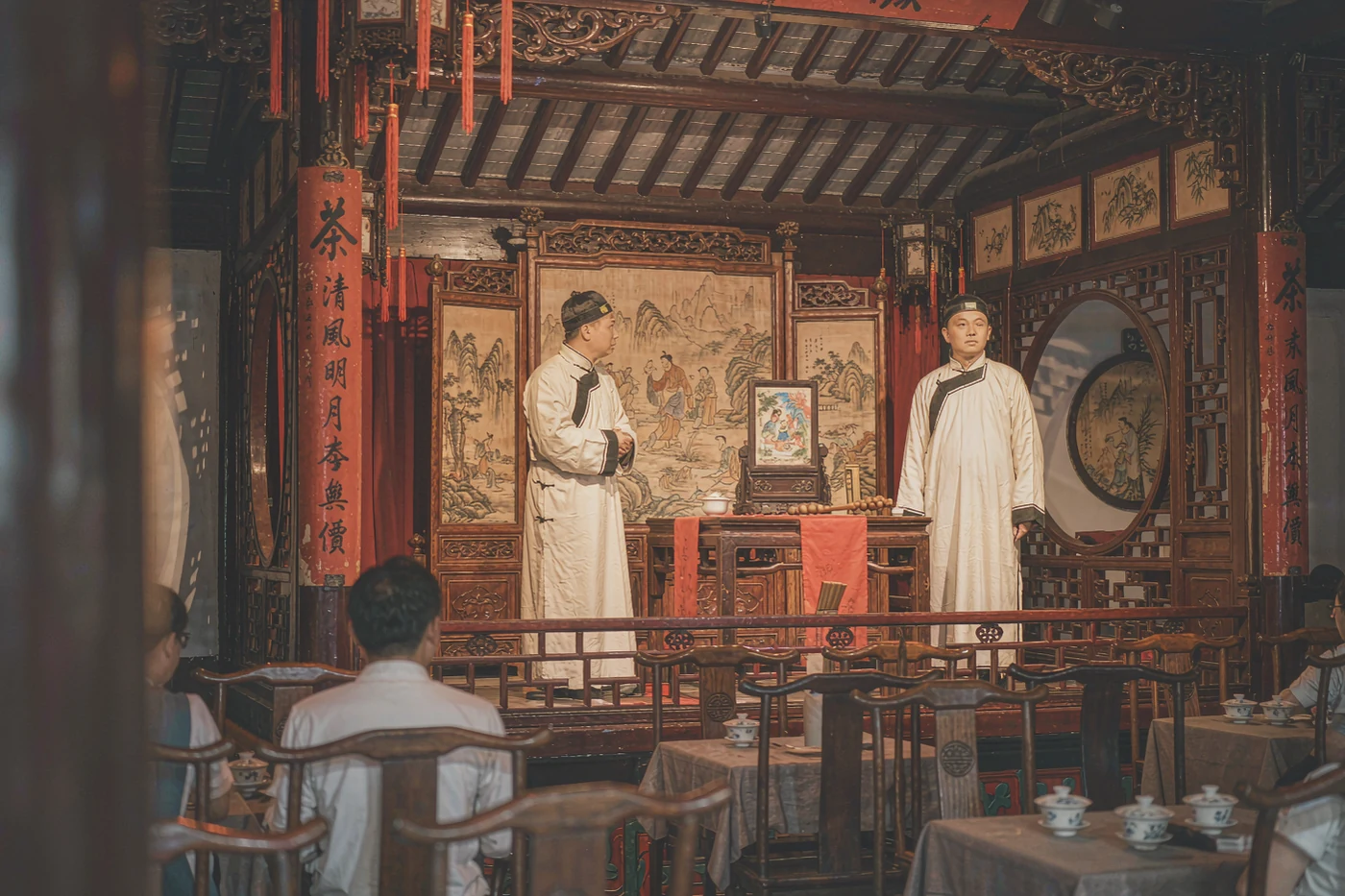
A small-theatre night is a variety bill, not a single act. Expect five to seven turns over roughly two hours, in a room of 100–300 people sitting around small tables with tea and sunflower seeds. The bill builds: junior pairs open, a stronger act in the middle, and the best pair closes the night (攒底, zǎn dǐ). If the crowd is loud enough the closer comes back for 返场 (fǎn chǎng), short encore bits that are often the loosest and funniest part of the evening. Weekend afternoons and evenings both run; weeknights are evenings only.
Two hours, five to seven acts — plus encore bits if the room is warm
100–300 seats around tea tables — the audience is part of the show; people shout back
Three formats — 单口 (solo), 对口 (two-person, the standard), 群口 (three or more)
攒底 is the closing act — the best pair of the night; 返场 is the encore after it
The vocabulary worth ten minutes
Crosstalk has its own four-skill checklist and a small jargon set. Knowing 说学逗唱 turns a wall of noise into something you can follow structurally, even when the words go straight past you.
说 (shuō) — talking — storytelling, tongue-twisters, delivery drills; the base craft
学 (xué) — imitation — dialects, animal noises, opera singing, street vendors' cries — the most language-free skill
逗 (dòu) — teasing — the joke-making, mostly carried by the 逗哏 (the funny one)
唱 (chàng) — singing — traditionally 太平歌词 (tàipíng gēcí), a clapper-accompanied chant; today often pop songs
捧哏 (pěng gén) — the straight man — fed lines, deadpan; his timing is half the joke
包袱 (bāofu) — the punchline — literally a cloth bundle; 抖包袱 is unwrapping it
现挂 (xiàn guà) — off the cuff — improvised riffs on that night's room; the reason locals rebook
How much you will actually understand
Be honest before you buy. Xiangsheng is verbal comedy in Mandarin, thick with Beijing slang, dialect impressions and references to whatever was in the news that week. With minimal Mandarin, expect to catch maybe a third of the punchlines — and still have a good night, because a surprising amount of it is not linguistic. 学 (imitation), the 柳活 singing and instrument-mimicry bits, the physical business with the fan, and the sheer rhythm of a room laughing together all land without translation. What you lose is the wordplay, the idioms and the topical satire, which is exactly what the locals came for.
Go for atmosphere, not comprehension — treat it like a gig in a language you half-know
Sit close and centre — the front tables catch facial work and the 现挂 aimed at the room
Bring a Chinese-speaking friend — one translator in the row roughly doubles what lands
Assume no subtitles — crosstalk halls run in Mandarin only; confirm before booking if a venue advertises English support [verify]
If you want to follow everything, pick a visual show — acrobatics and opera cross the language gap; crosstalk mostly does not
Tianqiao Deyun Theatre (天桥德云社剧场)
The flagship, at No. 1A Beilu Road in Tianqiao — historically Beijing's entertainment quarter — in a building converted from the 1933 Tianle theatre, with around 300 seats around tea tables [verify]. It runs an afternoon and an evening show, and the weekend evening is the hardest ticket in Beijing crosstalk: book one to two weeks out.
Metro
Line 8 to Tianqiao Station
Opening hours
Afternoon show roughly 14:00–16:30; evening show around 19:30
Tickets
Around ¥100–240 by seat tier [verify]
How long
About 2 hours
Deyun at Guangdelou, Qianmen (前门广德楼戏园)
The one most visitors end up at, because it sits inside Dashilan — the pedestrian street just south of Qianmen — so you can eat first and walk in. Two levels of small round tables, tea and seeds ordered by QR code; the front section downstairs is allocated seating while the rear is first-come within your zone, so arrive early. Book three to seven days ahead: almost nothing is left at the door, and touts outside mark tickets up heavily. Dashilan is pedestrianised, so a taxi cannot drop you at the entrance.
Metro
Lines 2 and 8 to Qianmen, exit C, about a 5-minute walk [verify]
Opening hours
Evening shows around 19:00 Tuesday to Sunday; afternoon shows around 14:00 at weekends; closed Mondays [verify]
Tickets
Roughly ¥150–350 by seat [verify]
How long
About 2 hours, typically six acts
Deyun Sanlitun Theatre (德云社三里屯剧场)
In the basement of Sanlitun SOHO at 8 Gongti North Road, this is the easiest one to bolt onto a night out: the 19:30 show lets out into one of Beijing's busiest bar districts. It is also the most visitor-friendly room in the chain simply because of where it is, and tickets are easier to get than Tianqiao's.
Metro
Line 10 to Tuanjiehu or Line 6 to Dongdaqiao, then walk
Opening hours
Afternoon around 14:00 and evening around 19:30
Tickets
Around ¥160–280 [verify]
How long
About 2 hours
Other rooms worth knowing
Deyun is the name everyone knows, but it is not the only game in town — the alternatives are usually cheaper and far easier to get into at short notice.
Hip-Hop Bao Fu Pu at Wukesong (嘻哈包袱铺五棵松剧场) — Basement of the Hi-Up complex at 69 Fuxing Road, Haidian; roughly ¥70–154, the cheapest reliable crosstalk in the city. Line 1 to Wukesong.
Sanqingyuan, Dashilan (三庆园) — 18 Dashilan Street, home to Deyun's eighth troupe; roughly ¥150–380 [verify]. Same street as Guangdelou, so compare dates.
Lao She Teahouse (老舍茶馆) — By Qianmen; its 京味儿相声专场 runs roughly ¥114–266. Easiest to book and tourist-friendly, but more of a variety bill than pure crosstalk [verify].
Da Dou Xiangsheng at Xuannan (大逗相声·宣南剧场) — Around ¥80–116, a young troupe and good value, with Chinese-only listings [verify].
Beijing Quyi Troupe at Tiantan Nanmen (北京曲艺团·天坛南门剧场) — Around ¥60–175 for a mixed bill where crosstalk sits alongside drum-song and clapper tales [verify].
Booking: apps, real-name tickets and the timing rule
This is the part that stops visitors. Tickets are sold inside Chinese apps, often in Chinese only, and they are real-name — the ticket is bound to an identity document that gets checked at the door.
Damai (大麦) is the main channel — search 德云社 plus the venue name; Maoyan (猫眼) carries some inventory too
Real-name means passport — register the passport you will physically carry; a photo on your phone is usually refused
Buy three to seven days ahead — weekend and holiday shows one to two weeks; a popular pairing can sell out within minutes of release
Six tickets per order, no refunds — most listings are non-refundable once issued — treat the date as fixed
Children — adult shows commonly refuse under-1.2 m, and every child over that needs a seat [verify]
When the app blocks you — hotel front desks can usually book a mainstream show; it is the single most reliable workaround
Small theatre night or big headline show
Two very different products share the name. The weekly theatre show is a rotating bill of working comedians in a 100–300 seat room, roughly ¥80–380. The 专场 (zhuān chǎng) is a touring headline show in a theatre of a thousand seats or more — Deyun ran its 30th-anniversary series through 2026 at venues including the Beijing Exhibition Centre Theatre — where tiers run from about ¥280 to ¥1,380 and the cheap seats sell first. First-timers are usually better served by the small room: the craft is the same, the crowd is closer, and you are not paying for a name.
Small theatre — ¥80–380, 100–300 seats, rotating bill, most nights of the week
Headline 专场 — ¥280–1,380, big theatre, one pairing or troupe, announced weeks ahead
At big shows, arrive about 60 minutes early — ID check plus bag screening; running time around 120 minutes [verify]
The cheap seats go first — at headline shows the lowest tiers sell out fastest — students and regulars are there at release
Getting your money's worth with limited Mandarin
Book the evening, not the afternoon — the 19:30 rooms are louder, and crosstalk feeds off a warmed-up crowd
Take a front-centre table — you read faces, not words; the back of the room loses half the act
Do not leave at the interval — the closing act and the 返场 encore come after it — that is the best part
Order the tea and seeds — QR code at the table, a few dozen yuan; it is part of the room and gives your hands something to do
Keep the phone in your pocket — filming is unwelcome and a flash will get you stared at
Learn four words — 逗哏, 捧哏, 包袱, 现挂 — enough to follow the shape of an act
Go to the toilet before it starts — walking out mid-act in a small room means crossing the whole audience
If crosstalk turns out not to be for you
It is entirely fair to decide the language gap is too wide. Beijing has easier evenings at a similar price: acrobatics and variety bills, which are almost entirely visual; Peking opera in its visitor-facing shortened form, where costume and surtitles carry the plot; and the 二人转 comic duos from the northeast at the Liu Laogen stage near Qianmen, which is broad physical comedy rather than verbal. The city's gig rooms are the other obvious fallback.