Explore Beijing / Seeing a Doctor in Beijing Without an Appointment: A Walk-In Guide for Foreign Visitors
Seeing a Doctor in Beijing Without an Appointment: A Walk-In Guide for Foreign Visitors
How to register at a Beijing hospital as a walk-in, take a queue number, and pay without a Chinese bank card — explained step by step for first-time visitors.
7 min read · KOULING's Beijing Travel Guide
You do not need an appointment to see a doctor in most Beijing hospitals. The system runs on same-day registration: you arrive, register at a desk or kiosk, take a number, and wait to be called. For a foreign visitor the main hurdles are language, the registration process itself, and payment without a local bank card. This guide walks you through all three. If your condition is serious — chest pain, trouble breathing, heavy bleeding, a suspected fracture — skip this and go straight to a hospital's emergency department (急诊, jízhěn) or call 120 for an ambulance. [verify before travel]
Step 1: Registering at the Desk (挂号 Guàhào)
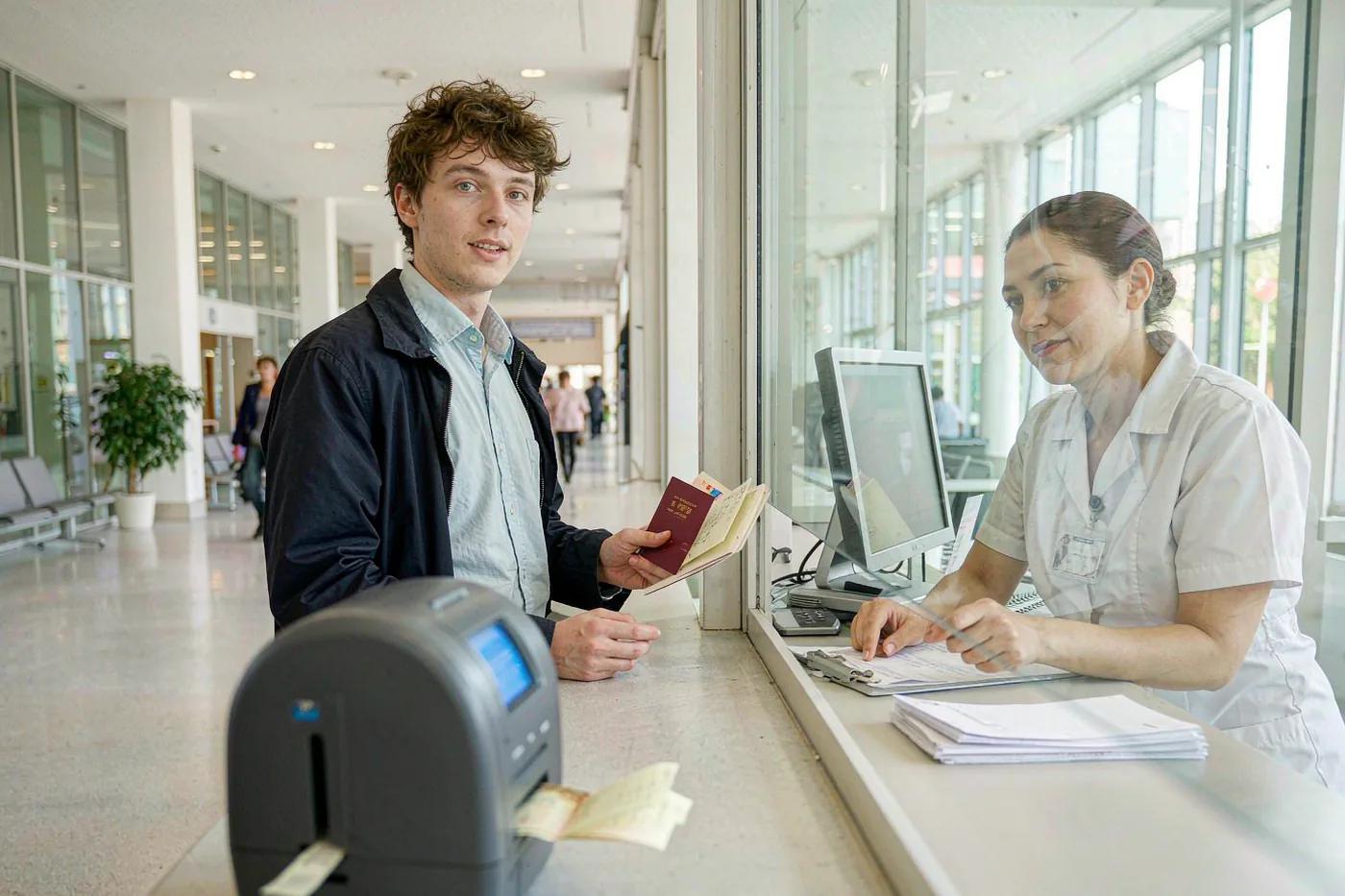
Registration is how every hospital visit starts. Large hospitals have both staffed registration windows and self-service machines; smaller neighbourhood hospitals are usually desk-only. As a first-time foreign patient, go to a staffed window — you cannot self-register on the machines without a Chinese ID. Bring your passport; it is required to create a patient file and will be linked to a temporary registration card or medical card the hospital issues you. Expect to pay a small registration fee that varies by doctor tier (roughly CNY 10–100 / USD 1.50–14 for a general or specialist consult). [verify before travel] Registration windows typically open early — often before 07:00 — and close in the early evening, though exact times differ by hospital. [verify before travel] If you speak little Chinese, write down your main symptom, and consider showing a translation app; many larger hospitals in central Beijing have some English capacity at international or VIP departments. [verify before travel]
Bring your passport — It is required for registration and payment records. A photo copy may not suffice at the counter — carry the original. [verify before travel]
Choose a department or let them choose — Common ones: 内科 (internal medicine), 外科 (surgery), 儿科 (pediatrics), 皮肤科 (dermatology), 眼科 (ophthalmology). If unsure, tell the registration staff your symptom and ask them to assign a department.
Ask for an English-speaking or international desk — Major hospitals such as Peking Union Medical College Hospital have international medical services; confirm current arrangements before you go. [verify before travel]
Morning is busiest — Local patients queue from very early. Mid-afternoon on a weekday is often the calmest walk-in window. [verify before travel]
Step 2: Queue Numbers and the Waiting Flow
After registering you receive a number (排队号 or a printed slip with your queue position). You then wait in the department's waiting area until a screen or nurse calls your number and doctor's room. The flow is usually: register → wait → consultation → any tests or imaging (paid separately, often in a different area of the building) → return to the same doctor with results → prescriptions → payment → pharmacy. Prescriptions are paid at a payment counter or machine before the pharmacy will dispense. Whole visit times vary enormously: a simple consult can take under an hour, while a visit involving blood tests often spans half a day because results take time to process. Build in the whole morning or afternoon.
Watch the screens — Departments display the current queue number on wall screens. Numbers are usually called in Chinese but the digits are shown visually.
Keep every slip — Registration slips, test requisitions and payment receipts are all needed at later steps in the same visit.
Results may take hours — Blood work commonly returns the same day; some imaging may be scheduled for another day. [verify before travel]
Step 3: Paying Without a Chinese Bank Card
Chinese hospitals are heavily digital, but cash and foreign cards are not always accepted at every counter, and the situation keeps changing. Your most reliable options: (1) Alipay or WeChat Pay linked to a foreign Visa/Mastercard — set this up before you travel, and test a small payment first, because international card top-ups occasionally fail and limits apply; (2) cash in RMB — accepted at many hospital cash counters, though some self-service machines take cards or QR codes only; (3) ask staff where the 人工收费窗口 (staffed payment window) is, since that is where cash and card payments are handled. As a foreigner you cannot rely on a hospital app tied to a Chinese ID number. Budget several hundred CNY (tens of USD) for a routine consult plus basic tests, more if imaging or medication is involved — and keep all receipts if you plan to claim on travel insurance. [verify before travel]
Set up Alipay or WeChat Pay before travel — Link your foreign card in advance and test it. Some hospitals accept payment QR codes at kiosks; staffed counters are the fallback. [verify before travel]
Carry cash — Bring small notes (CNY 10/20/50) for registration and prescription fees at cash windows. [verify before travel]
Travel insurance — Most Beijing hospitals require payment up front and give itemized receipts (发票, fāpiào) you can submit for reimbursement. Ask for the official receipt, not just a payment slip.
Emergency costs — Emergency treatment is paid the same way. If costs could be large, contact your insurer's hotline before or during treatment. [verify before travel]
Choosing Where to Go
Beijing's top-tier hospitals are outstanding but crowded and often short on English. For a minor ailment, a district-level hospital or an international clinic is usually faster and easier. Three practical options below cover the main scenarios. Pharmacies are also a legitimate first stop for simple complaints like a cold — look for a big green cross sign (药店).
Serious or urgent — Go to a large hospital's 急诊 (emergency) entrance, open 24 hours; it has its own registration. [verify before travel]
Minor illness — A district hospital walk-in will be quicker than a famous national hospital.
Want English — International departments at major hospitals, or private international clinics, cost significantly more (often several hundred to over a thousand CNY, i.e. USD 40–150+) but have English-speaking staff. [verify before travel]
Peking Union Medical College Hospital (PUMCH)
One of China's most respected hospitals, in central Beijing near Dongdan. It has international medical services used to foreign patients, but main-site outpatient areas are extremely busy — arrive early. Confirm which campus handles foreign walk-ins before you set off. [verify before travel]
Metro
Nearest stations: Dongdan on Lines 1 and 5 — confirm current exit and walking route. [verify before travel]
Opening hours
Outpatient registration typically opens early morning; exact windows vary by campus. [verify before travel]
Tickets
Registration fee varies by doctor tier, roughly CNY 10–100 / USD 1.50–14; international department costs much higher. [verify before travel]
How long
Allow half a day for a consult with basic tests.
Beijing Friendship Hospital
A large, well-regarded general hospital in Xicheng District, historically known for treating international patients. Its outpatient building runs the standard register-and-queue walk-in flow described above. Check current language support and payment options before visiting. [verify before travel]
Metro
Served by the subway network in south-west central Beijing — confirm the current nearest station and line. [verify before travel]
Opening hours
Outpatient services mainly daytime on weekdays; emergency department open 24 hours. [verify before travel]
Tickets
Tiered registration fees, roughly CNY 10–100 / USD 1.50–14 for standard consults. [verify before travel]
How long
Plan for 1–4 hours depending on tests.
Your District Hospital or Community Health Centre
For colds, minor injuries, prescriptions and vaccines, a neighbourhood community health centre (社区卫生服务中心) or district hospital is far less crowded than a national flagship hospital. Staffed registration windows take passports, and queues are short. English ability is limited, so bring a translation app or a written note of your symptoms in Chinese.
Metro
Usually within walking distance or one short metro/bus ride of most residential and hotel districts — ask your hotel front desk for the nearest one. [verify before travel]
Opening hours
Typically daytime, Monday–Friday, some weekend mornings; confirm locally. [verify before travel]
Tickets
Low registration fees, often under CNY 50 / USD 7. [verify before travel]
How long
Often under an hour for simple complaints.
Practical Tips Before You Go
Save key phrases — I need to see a doctor = 我要看病 (wǒ yào kànbìng); where do I register = 在哪里挂号 (zài nǎlǐ guàhào); pain here = 这里疼 (zhèlǐ téng).
Bring your medications list — Write down any medicines you take, with generic names, and any allergies — in English and Chinese if possible.
Your hotel can help — Ask the front desk to write the hospital name and department in Chinese and, if possible, to call ahead and confirm walk-in registration for foreigners that day. [verify before travel]
Know the emergency numbers — 120 is the medical emergency ambulance number nationwide; 999 is an additional Beijing number — verify which applies to your situation. [verify before travel]
Pharmacy first for minor issues — Pharmacists can advise on coughs, colds and upset stomachs without any registration at all.