Explore Beijing / Beijing Hotel Room Problems: How to Get a Room Change or a Refund
Beijing Hotel Room Problems: How to Get a Room Change or a Refund
Noisy street, smoky room, dead air-conditioning? How Beijing hotels handle room changes, what you are entitled to, and when a refund is actually realistic.
11 min read · KOULING's Beijing Travel Guide
You checked in, dropped your bags, and the room is not what you paid for: traffic roaring under the window, a stale smoke smell, an air-conditioner that only blows cold in November, or a shower that will not get hot. In Chinese hotels a room change is a normal, routine request — front desks handle these all week — and knowing how to ask, what to ask for and when to escalate turns a frustrating night into a five-minute fix. This guide covers the practical playbook for Beijing: what to test in your first ten minutes, the phrases that work at the desk, what you can reasonably demand when the hotel is full, and the escalation ladder if the answer is no.
Test the room before you unpack
Your leverage is highest in the first ten minutes, before your luggage is open. Once you have unpacked, staff know you are unlikely to move, and every request gets slower and weaker — this is the single most common regret travelers report. Walk in, run the checks below, and if anything fails, go down to the desk while your suitcase is still by the door. Take photos or a short video the moment you find a problem: a timestamped photo of a dead thermostat is what turns "there was some noise" into a case the hotel takes seriously.
Air-conditioning and heating — Set it to the temperature you want and let it run five minutes. A unit that blows but never cools is the most common Beijing complaint in summer.
Hot water — Run the shower for 30 seconds. lukewarm water at 7 a.m. is common in older buildings; a better room or a different floor often fixes it.
Windows and street noise — Close everything and stand still for a minute. If a main road roars through the glass, you want to know before 11 p.m., not at 2 a.m.
Smell — Cigarette smoke, fresh paint or mold means ask for a change now — scented sprays mask it for an hour, not a night.
WiFi strength — Load a video on your phone. Rooms at the end of long corridors are the usual dead spots; switching rooms is easier than living in the lobby.
Safe, fridge and kettle — Open all three. Electronics fail silently, and a dead in-room safe discovered at midnight is a front-desk errand you do not want.
How to ask for a room change
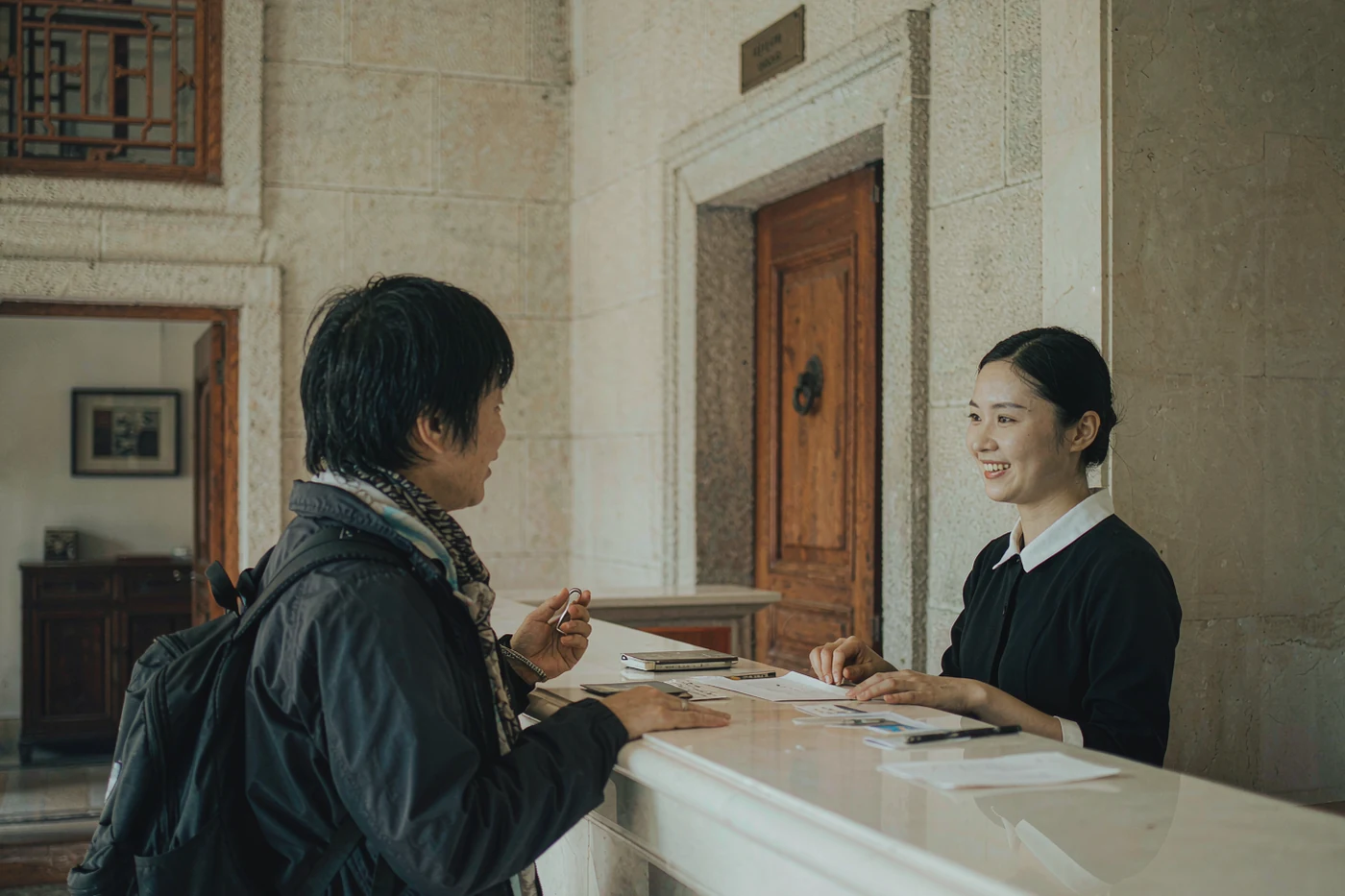
Go to the front desk in person rather than calling from the room — decisions and keys are at the desk. State the problem plainly and make one concrete request: "The air-conditioning is broken and there is a burning smell. Could you move me to another room?" Chinese front desks process room changes as routine maintenance logistics, not as a complaint, so a calm, specific request usually gets a new key card within minutes. If the fault is clearly the hotel's, they will often move you up a category for free rather than argue about it.
Ask for what you actually need — A quiet room on a high floor away from the elevator is a standard, reasonable request — say it as one sentence, not a list of grievances.
If they say the hotel is full — Ask what becomes available after 9 p.m., when no-shows and short-stay guests free up rooms. Inventory changes hourly and the desk knows it.
Watch for a downgrade — If you booked a specific room type and the replacement is a lower category, that is a downgrade — a partial refund or a free upgrade for a later night is fair to ask for.
Bridge the language gap — Many desk clerks manage basic English but freeze under pressure. Type your sentence into a translation app and show the screen; a written Chinese phrase works better than slowly repeated English.
Get the new room checked too — Walk into the replacement room and run the same five-minute test before signing anything. Moving from a broken AC to a smoky room is a real possibility.
What each common problem actually needs
Not every problem is a room-change problem, and asking for the wrong fix wastes your strongest moment. Match the complaint to the remedy:
Street or bar noise — Ask for a room facing the interior courtyard or on a higher floor. Pack earplugs as backup, but the room change is the real fix.
Smoke smell — Indoor smoking is banned in Beijing hotels, so a smoky room justifies an immediate change. If the whole floor smells, ask for a different floor — the smell lives in the carpets and curtains.
Air-conditioning weak or wrong temperature — Many Beijing buildings switch central systems between heating and cooling mode seasonally, and in spring and autumn a locked-out mode can look like a broken unit [verify]. Ask the desk to switch the mode before demanding a new room.
No or weak hot water — One cold shower may be a valve; a whole floor with no hot water is a maintenance failure the hotel must fix or re-house you for.
Noisy neighbors — Do not knock on their door. Call the front desk — enforcing quiet hours from around 10 p.m. is the hotel's job, and a call from the desk lands softer than a confrontation [verify].
Construction noise nearby — Beijing bans noise-polluting construction between 22:00 and 06:00 in noise-sensitive areas such as residential clusters, schools and hospitals (city government notice Jingzhengfa [2015] No. 30). Machinery humming at 3 a.m. means the hotel sold you a room it knew was noisy — push firmly for a move.
If the hotel says it is fully booked
This is where travelers give up too early, because the law is more on your side than most assume. Under Article 577 of the Civil Code, a hotel that promised a working facility — or plainly should provide one — and fails to deliver is in breach of contract. Consumer-council guidance across China treats a broken essential facility as grounds to demand another room of at least the same standard, at the hotel's cost if the replacement is better, or to check out with a full refund of that night [verify]. One published benchmark from a Zhejiang consumer council for guesthouses — a regional guideline rather than a Beijing statute, though hotels generally treat it as the expected norm — suggests that if you stay in the original room, compensation of no less than 30 percent of the night's rate; if you leave, a full refund plus reasonable costs you incurred. In documented mediations, a broken air-conditioner in a fully booked hotel ended with the night's rate refunded in full.
Ask in this order — Any replacement room → a better room at no charge → a discount or partial refund → checkout with a refund of unused nights. Each step is normal; asking for all of them at once is not.
Let the hotel solve it their way — A hotel at full occupancy will sometimes book you into a partner property nearby and pay the difference. That is a perfectly good outcome — accept it.
Put every offer in writing — Before accepting anything, get the duty manager to state the arrangement in the hotel app chat or on paper: what room, what compensation, whose cost.
When a refund is actually realistic
Consumer-council guidance draws the line clearly, and knowing it saves you an ugly scene. A broken lamp, an hour without hot water, or a slow elevator are not fundamental breaches — you will not get a full refund for those, and demanding one just burns the goodwill you need. You are on solid ground for a full refund of unused nights only when the fault is serious and unfixable and the hotel refuses both a room change and compensation: no hot water for the whole stay, an air-conditioner that cannot be repaired, basic functions of the room simply not working. For everything in between, a partial discount — often 10 to 30 percent of the night — is the normal outcome for a problem that was annoying but livable [verify]. Your deposit is separate from all of this: it is refunded at checkout regardless of any dispute.
Full refund territory — You check out early because the hotel cannot house you properly and will not move you. Refund of unused nights, plus reasonable extra costs, is the standard mediation result.
Partial discount territory — You keep the room because the fix is tolerable. Name a number yourself — 20 percent off the night is a normal opening position.
Not refund territory — Service attitude, a slow lift, one flickering bulb. Ask for the fix, take the free breakfast if offered, and move on.
The escalation ladder, in order
If the desk stonewalls you, escalate in this order. Each step works because the previous one produced no result — skipping straight to shouting gets you nowhere in China.
1. Duty manager — Ask for the duty manager (值班经理) by name. Front clerks have limited authority to comp a night; the duty manager has more, and just naming the role changes the conversation.
2. Your booking platform — If you booked through Trip.com, Booking.com or Fliggy, open their in-app chat while still at the desk. Platforms mediate hotel disputes daily and can authorize partial refunds themselves; Trip.com support runs around the clock in English.
3. 12315 — The national market-regulation consumer hotline handles hotel service disputes. The hotline is Mandarin-only; the 12315.cn website and its WeChat mini-program accept complaints online and let you attach photos [verify].
4. 12345 — The Beijing city government service line, useful for noise complaints and safety issues; it routes your case to the district authority that supervises the hotel.
5. Police 110 — Only for actual crimes — a hotel refusing to return a deposit, threats, or something stolen. Service complaints do not belong here. For payment and overcharge disputes specifically, see our guide on what to do when you are overcharged.
Noise rules that back you up
Two Beijing rules give your noise complaint teeth. First, noise-polluting construction is banned between 22:00 and 06:00 in noise-sensitive areas — around residential compounds, schools and hospitals — and only continues at night with an explicit permit. Second, indoor smoking is banned in all public indoor places in Beijing, hotels included, so a smoky room is not a preference issue but a violation. You do not need to cite either law to the front desk — knowing they exist tells you which requests are entitled rather than merely polite.
Construction next door at midnight — Illegal without a night-work permit. The hotel either moves you or explains to 12345 why it sold the room — both cost them more than a new key card.
Renovation noise inside the building — Renovation work in occupied buildings is restricted to regulated daytime windows; all-day drilling in your corridor is a legitimate, winnable complaint.
Someone smoking in the next room — Report it to the desk, not the smokers. Hotels enforce this seriously because they are the ones fined.
Phrases that work at a Chinese front desk
换个房间吧 — Huan ge fangjian ba — "let's change rooms." The whole request in five characters; start here.
空调不制冷 / 不制热 — Kongtiao bu zhileng / bu zhire — the AC does not cool / does not heat.
没有热水 — Meiyou reshui — there is no hot water.
房间里有烟味 — Fangjian li you yanwei — the room smells of smoke.
隔壁太吵了,请帮忙提醒一下 — Gebi tai chao le, qing bangmang tixing yixia — the neighbors are too loud, please remind them.
有安静一点的高层房间吗? — You anjing yidian de gaoceng fangjian ma? — do you have a quieter room on a high floor?
请叫值班经理 — Qing jiao zhiban jingli — please call the duty manager. Use it when the desk stops being helpful.
Mistakes that weaken your case
Unpacking before testing — The moment your clothes are in the wardrobe, your willingness to move drops — and so does the hotel's urgency.
Waiting until midnight to complain — Ask at check-in or by 9 p.m., while rooms are still free and the full staff is on duty. A 1 a.m. request meets a skeleton crew and a full house.
Refusing to settle the bill — Not paying at checkout escalates a service dispute into a genuine conflict that police may get called to. Negotiate the discount, get it written down, then pay.
Going straight to social media — Public complaints posted before the hotel has had one chance to fix things close off the easy resolutions. Escalate privately first, review publicly after.
Losing the paper trail — Every promise — new room, discount, free night — confirmed only verbally will evaporate at checkout. Get it in the hotel chat, on paper, or as a note under your booking.