China's most social meal, decoded for first-timers: copper-pot lamb versus Sichuan spice, how to build a sesame sauce, how long to cook everything, classic restaurants and budget solo options.
Hotpot — huǒguō, the bubbling pot of broth set in the middle of the table — is the meal Chinese people cook when they celebrate, when winter arrives and when they want to keep a table for four hours. Beijing has its own branch of the tradition: tall copper pots, paper-thin hand-cut lamb and a sesame sauce ritual locals treat with near-religious seriousness. For a first-time visitor, hotpot can also be the most confusing meal in China: nothing arrives ready to eat, the menu is a list of raw ingredients, and the sauce station looks like a chemistry lab. This guide explains the two hotpot traditions you will meet, how to choose a broth, what to do at the sauce counter, how long to cook each ingredient, where the classic restaurants sit and what a realistic budget looks like. It stays inside restaurants: reading a Chinese menu has its own guide, the Niujie halal food street is covered separately, and hotpot kits delivered to your hotel are a delivery-app story.
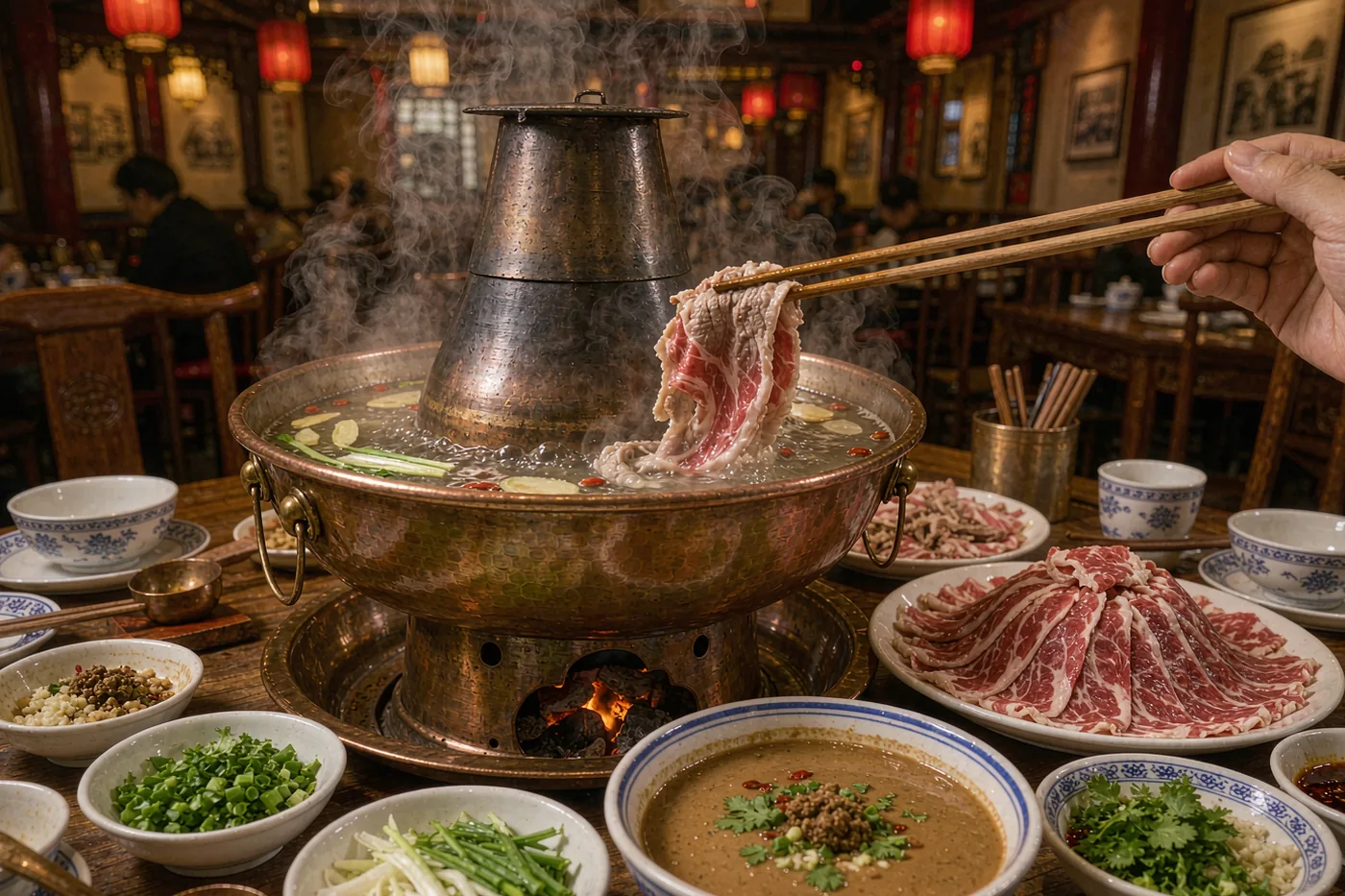
Beijing sits at the meeting point of China's two hotpot worlds, and your first choice is between them. The local classic is copper-pot lamb (涮羊肉, shuàn yángròu): a tall copper pot, traditionally over charcoal, filled with plain water perfumed with scallion, ginger, dried shrimp and dried mushrooms. The broth exists to cook, not to season — flavor comes from the lamb itself and from your sesame dip. Sichuan-style hotpot is the opposite philosophy: a fiery beef-tallow broth loaded with chilies and numbing peppercorns that is the whole point of the meal, paired with ingredients built to soak it up. When your table cannot agree, order a yuan-yang pot (鸳鸯锅) — a single vessel divided down the middle with clear broth on one side and spice on the other. A third format, the individual mini-pot (小火锅) where every diner boils their own small vessel, is the fast-growing budget option; it gets its own section below.
At a traditional copper-pot restaurant the clear broth is usually the default and often costs nothing or a token fee; flavored broths such as tomato (番茄) or mushroom (菌汤) typically run ¥10–30 [verify]. At Sichuan-style houses the spicy beef-tallow base usually costs ¥30–60 [verify], and menus list spice levels from mild (微辣) through medium (中辣) to extra hot (特辣) — take medium on a first visit; local extra-hot is genuinely aggressive. Chain restaurants offer a four-grid pot (四宫格) that lets your table mix four half-size broths in one vessel, which is the easiest way to hedge: one clear, one mushroom, one mild spicy, one for the brave. Vegetarians should note that even a clear broth at a lamb house is a meat-adjacent liquid; mushroom or tomato broths are the safer base, and a few chains carry dedicated vegetable stocks.
At copper-pot houses the dip is not brought to you — you build it at a counter, and the base is always sesame paste mixed with peanut paste in roughly an 8:2 ratio, locally called er-ba sauce (二八酱). Ladle a few spoonfuls into your bowl, then customize from the usual lineup: fermented bean curd (腐乳, salty and funky), chive-flower paste (韭菜花, sharp and savory), chili oil, minced garlic, scallion and cilantro. Veterans go light: the paste should coat a slice of lamb, not drown it, and the classic Beijing move is a little extra chive-flower paste and nothing else. A sauce-counter seat typically costs ¥5–12 per person [verify]; at Sichuan-style restaurants the dip is a standard dry oil-and-garlic bowl instead, since the broth already carries the seasoning. One warning from the locally experienced: sesame sauce is filling. First-timers routinely overfill their bowls and run out of appetite before the good lamb arrives.
The menu is a list of raw ingredients sold by the plate, and at a proper copper-pot house the headline item is hand-cut fresh lamb (手切鲜羊肉) — expect roughly ¥40–80 a plate at mid-range houses [verify]. Frozen pre-sliced lamb and beef run cheaper, ¥25–45, and rolls of marbled beef (肥牛) are the safe order for a mixed table. Classics worth adding: lamb with a bit of crunchy cartilage (高钙羊), hand-shrimp paste (虾滑), frozen tofu (冻豆腐, which drinks broth), lotus root, potato slices and greens at ¥10–25 a plate. Two Beijing-specific sides almost never miss: the sesame-coated sugar biscuit called shaobing or tangbing, baked on site and used to mop the sauce, about ¥3–8 each [verify]; and sugar-cured garlic (糖蒜), the palate-cleansing counterpoint to rich lamb. For a table of two, three plates of meat plus four to five vegetable plates is a full dinner.
Four institutions anchor the copper-pot tradition. Donglaishun (东来顺), founded in 1903, is the famous brand with its flagship on the fifth floor of the APM mall at Wangfujing — touristy but reliable, roughly ¥130–150 per head [verify]. Jubaoyuan (聚宝源) on Niujie is the current queue king for halal copper-pot lamb, around ¥100–130 per head with queues of one to two hours on weekends [verify]; our Niujie guide covers the street around it. Manhengji (满恒记) near Ping'anli station is the connoisseur pick, famous for its sugar pancake, about ¥110–130 per head [verify]. Nanmen Shuanyanrou (南门涮肉) by the south gate of the Temple of Heaven, about ¥110–130 [verify], makes a natural stop after a morning in the park. For atmosphere, Rayer Li Ji (鸦儿李记) beside the Silver Ingot Bridge at Shichahai serves the lakeside view with its lamb, around ¥80–130 [verify]. All of these take remote queue numbers through the Dianping or Meituan apps — take a number before you walk over.
Hotpot looks like a group meal, but Beijing quietly solved the solo problem years ago. Xiabuxiabu (呷哺呷哺) pioneered the counter-format mini-pot — one diner, one small vessel — and its average check sits around ¥50–60 [verify]; you sit at a bar, order plates from a menu and cook at your own pace. Haidilao (海底捞), China's service-famous chain with an average check just under ¥100 [verify], welcomes solo diners and famously seats them with a giant teddy bear across the table; its four-grid pot works for one person ordering small plates. The newest wave is the mini-hotpot storefront (小火锅), where every seat has its own pot and buffet plates cost a few yuan each — a full dinner can land at ¥20–40, with many shops promoting ¥9.9 broths [verify]. For a first hotpot experience alone, a counter format removes all the social pressure while keeping the ritual intact.
Peak dinner hours run roughly 18:00–20:30, and the famous houses live up to their queues: on weekends expect an hour or more at Jubaoyuan or Manhengji, less at neighborhood branches. The practical move is the remote queue — open the Meituan or Dianping app (or the restaurant's own mini-program inside WeChat), find the shop and take a queue number before leaving your hotel; the app shows your position live. Payment is scan-to-pay at the table or at the counter, and cards work at most chain locations. There is no tipping and no service charge anywhere on this list. Portions are per plate rather than per person, so the table splits the bill evenly or one person pays the QR code and friends settle up privately — nobody audits who ate what.
Hotpot is friendlier to restricted diets than most Chinese food culture, with one caveat. Vegetarians should pick a mushroom or tomato broth and build a meal from tofu (fresh, frozen and fried), mushrooms, lotus root, greens, noodles and egg dishes — most menus carry all of these, and chains like Haidilao have dedicated vegetarian recommendations. Halal diners have it easy in Beijing: the entire copper-pot lamb tradition runs through Muslim restaurants, and Jubaoyuan on Niujie is the best-known halal hotpot house in the city. Seafood and chicken options exist everywhere; pork rarely appears at copper-pot houses. The one genuine gap is severe allergies — broths are shared, cross-contact is constant, and the sauce counter has no ingredient labels, so travelers with serious allergies should follow the precautions in our food allergies guide rather than improvising at a hotpot table.