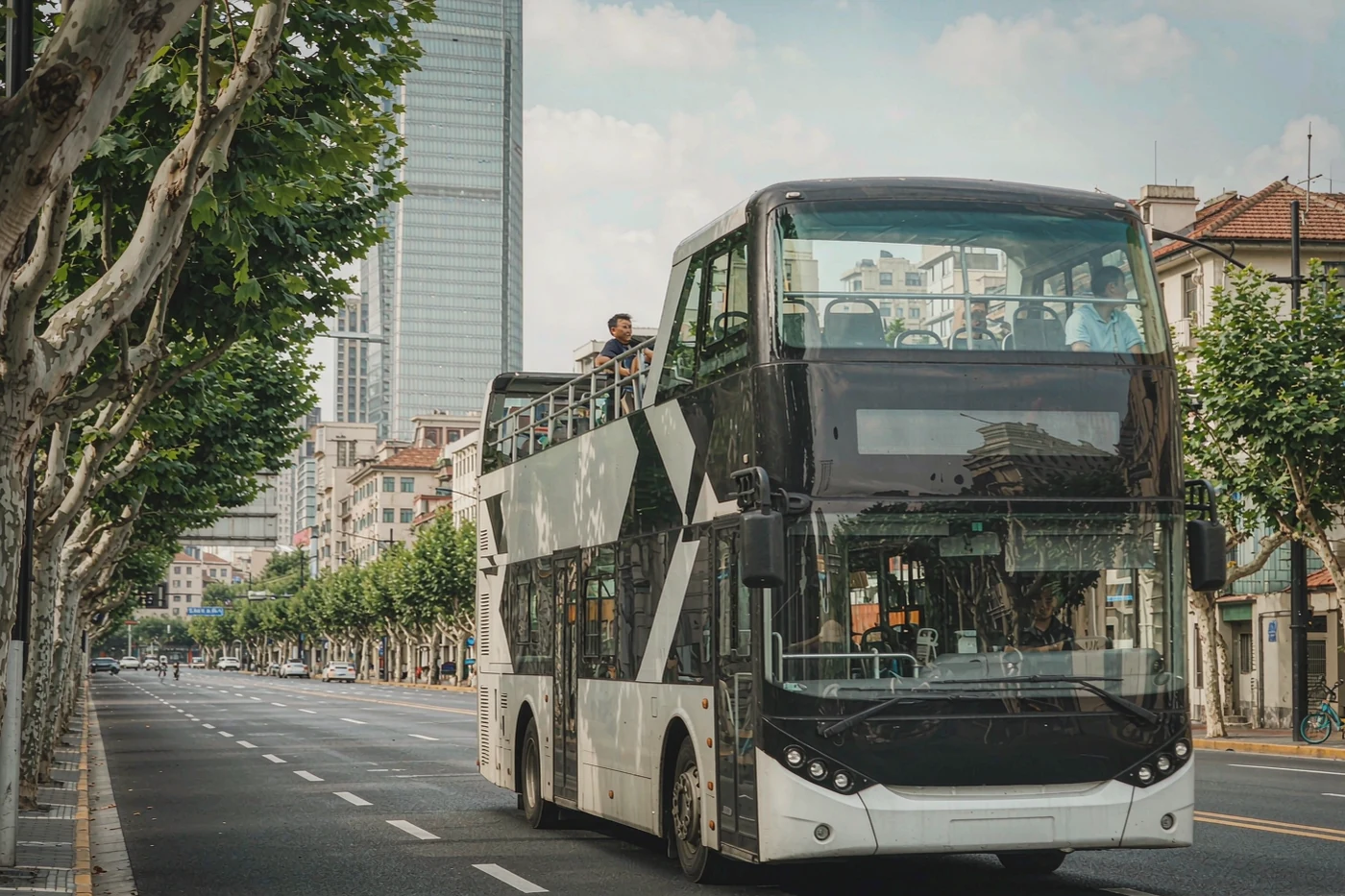
Beijing runs two sightseeing-bus systems that share almost nothing: cheap retro loops past the Forbidden City and guided axis tours at 5 to 25 times the price. Routes, fares, hours and when the bus genuinely beats the metro.
Every first-time visitor photographs Beijing's retro sightseeing buses: the green-and-cream dangdang cars (铛铛车, named for the bell of the city's old trams) crawling past Tiananmen and the Forbidden City. Few realise that 'the sightseeing bus' is really two separate products from two operators, at prices from roughly 10 to 268 yuan. Pick the wrong one and you either pay guided-tour money for a plain bus ride, or miss the commentary you were counting on. This guide maps both systems and settles the honest question: when, if ever, does the bus beat the metro?
The numbered Sightseeing Lines 1–3 (观光1线/2线/3线) are ordinary bus routes run by Beijing Public Transport Group: retro-styled vehicles, a conductor on board selling tickets, fixed stops you can get off at, and fares in the 10–20 yuan range. The themed products — the 'Grand Central Axis' dangdang bus, the Chaoyang night buses and their siblings — are run by the Beijing Tourism Distribution Center (北京旅游集散中心): guided, no intermediate stops, sold online, priced at 50–268 yuan. Published fares for the numbered lines differ slightly between sources, so treat every number in this guide as an approximation [verify].
A 21-stop loop that starts and ends at Yongdingmen Inner (永定门内), tracing the southern and central axis: the Temple of Agriculture (先农坛), the Tianqiao performing-arts quarter, the Dashilar shopping street, both sides of Tiananmen Square, the Forbidden City's west side, Zhongshan Park and Beihai Park. Departures run roughly 08:00–17:00 [verify]; the full loop costs about ¥15 in cash or ¥10 with a transit card [verify]. For many visitors this one line covers half of the 'classic Beijing' checklist without a single metro transfer.
A tighter 15-stop loop anchored at Qianmen (前门), adding what Line 1 skips: the Forbidden City's east side via Beichizi (北池子北口, 故宫东门), the Donghuamen food-street area and the Wangfujing shopping district, before returning past Tiananmen Square. Hours are roughly 08:00–17:00 in peak season and 08:30–17:00 off-season [verify]; fares match Line 1 at about ¥15 cash / ¥10 card [verify]. Boarding at Qianmen is the easiest choice for most tourists — the stop sits right below the rebuilt archway.
The odd one out: instead of looping downtown, it links the palace area with northwest Beijing, running via Deshengmen (德胜门), the Olympic-green area (北辰东路), the Wudaokou–Zhongguancun university belt, the Old Summer Palace's south gate (圆明园南门) and finally the Summer Palace's north gate (颐和园北宫门). Published hours are roughly 09:00–16:00/17:00 depending on direction [verify], with fares around ¥20 cash / ¥15 card [verify]. Sources disagree on parts of the intermediate routing, so check the posted stop list before relying on it as a connection. The reward: you reach the Summer Palace from the Forbidden City in one seated ride instead of three metro transfers.
This is the ¥50 product, and it is a different experience entirely: a replica-style electric dangdang car running one-way from Qianmen to the Drum Tower (鼓楼), daily 10:00–17:00, 12 km with no intermediate stops, passing Zhengyangmen, Yongdingmen, the Temple of Heaven, Tiananmen Square, the Forbidden City, Jingshan, Wanning Bridge and the Bell-and-Drum Towers. A bilingual guide narrates the UNESCO-listed Central Axis (inscribed 2024) through the whole ride, and themed souvenirs are sold on board [verify]. The night version is a ¥268 package: book online at least one day ahead (it runs only with 10 or more passengers, departing around 19:00), a 25 km loop with a folk performance and a choice of roast-duck or western-style meal; children under 1.3 m ride free without a seat.
The themed fleet changes with the seasons. From mid-April to mid-October, the Chaoyang (潮朝阳) night bus links Qianmen with the lakeside shopping district Solana (蓝色港湾), departing 18:00 and returning from 20:30, bundled with a Liangma River boat ride; a second route runs from the Bird's Nest toward Yansha wharf. Official media also list a Chang'an Street night line and a Qianmen–Forbidden City loop among the eight themed products launched in August 2024. The exact lineup and hours rotate year to year — confirm on the operator's online platforms before you plan an evening around one [verify].
For Lines 1–3 there is nothing to book: wait at the marked stop, board, and pay the conductor in cash or with a Yikatong transit card — no passport, no real-name check, no app. The themed buses are the opposite: the daytime axis bus sells tickets at the Qianmen departure point and online, while the ¥268 night tour and seasonal routes are online-booking only. These sightseeing products do not accept foreign contactless bank cards the way the metro now does — bring RMB cash, or set up an Alipay/WeChat transit code before you board [verify].
Metro Line 8 runs directly beneath the Central Axis (Qianmen, Wangfujing, Nanluoguxiang, Shichahai, Drum Tower), Line 1 runs under Chang'an Street, and both cost ¥3 and up with trains every few minutes. The bus is slower, rarer, and stuck in the same traffic as taxis. But it wins in four specific situations: your first jet-lagged morning, when orientation matters more than speed; with small children who cannot manage the two kilometres between gates; in rain or 35°C heat, when a seated ride with a window beats a subterranean tunnel; and in the gap between two timed bookings, when you need rest rather than another staircase. Locals take the metro; smart tourists take the bus once, deliberately, then switch.
A sensible first-day plan: board Line 1 at Qianmen around 13:00, ride to the palace's north side, walk into Jingshan Park for the panoramic view over the golden roofs (allow 30–45 minutes), then stroll down to Beihai's lakeside, and finish by riding or walking south to Dashilar for an early dinner — most shops there close by about 21:00. Every hop-off point sits on the axis or within a 10-minute walk of it, and 10–15 yuan per boarding means the whole afternoon's transport costs less than one Didi ride. Save the ¥50 axis tour for a poor-weather second morning: its commentary is genuinely informative and the seats are comfortable.