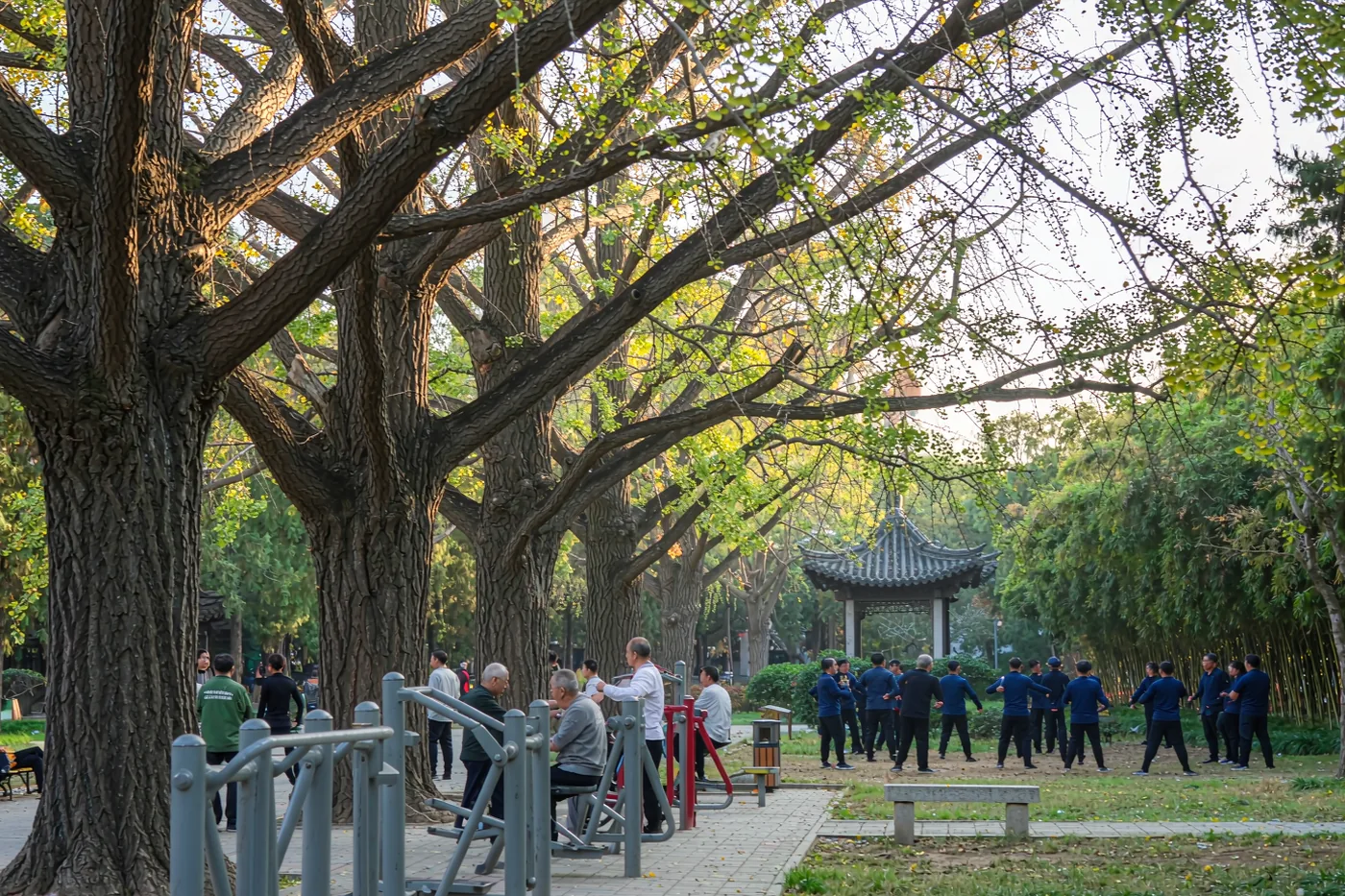
Every Beijing park doubles as a free open-air gym at dawn and after dark. How the equipment works, the unwritten rules of square dancing, and how to join in.
Before the tour buses move and while most visitors are still asleep, Beijing's parks are already busy with something better than any staged culture show: the city exercising in public. Retirees run the space-walkers, dance teams fill the hard plazas, calligraphers paint with water on the paving stones, and none of it costs a cent. For long-stay visitors this is the cheapest, friendliest daily routine in the city — and joining in is easier than it looks. This guide covers the equipment itself, the unwritten rules, and how to take part without feeling like an intruder.
Beijing treats exercise as public life, not gym time. Every residential compound, riverside walk and park has its own patch of free equipment and its own regulars, so the scene exists within a few minutes' walk of anywhere you might stay. The crowd is overwhelmingly local and mostly retired — which is exactly why visitors are welcomed rather than sold to. There is no ticket, no booking, no membership: just show up, watch for a few minutes, and the rhythm of the place becomes obvious.
The fitness corners (健身角) that the city installs in parks and housing estates are built around a standard cast of machines, all free and first-come. They look intimidating but are simpler than they appear — each one moves in a single plane, and the instructional plaque on every machine shows stick-figure diagrams.
The gear is public infrastructure with real rules behind it. Suppliers must meet the national safety standard GB 19272-2011 for outdoor fitness equipment, and every machine must carry an instruction plaque with safety warnings, the installation date and — usefully — a repair hotline or QR code for reporting damage [verify on-site]. Ground under fall-risk machines is supposed to have a cushioned surface. If something is broken, do not attempt DIY fixes: call the number or scan the code on the plaque, or tell the park office.
Nobody will explain the rules to you; you are expected to read them off the crowd. The good news is that they are all common sense.
The loudspeakers at dusk belong to square dancing — choreographed group routines done by teams of dozens. Beijing's parks authorities allow dancing as long as noise stays within limits, and some teams now dance to wireless headphones, which looks surreal and sounds wonderful. Joining is genuinely allowed: walk to the back row, copy the arm movements first (feet follow naturally), and expect the leader or a neighbour to help you along. There is no fee for casual participation [verify — a few organised teams collect token monthly charges]. The one real faux pas is stopping mid-floor to film yourself.
You can watch everything, and wide shots of a dancing crowd are unremarkable here. Close-ups of identifiable people are different: ask without words by raising the camera and nodding — a nod back means yes, a wave means no, and both are final. Never photograph children up close, do not fly drones over the crowd, and do not position yourself directly in front of a dance leader or tai chi instructor — the whole group faces that person.
Between the machines and the dancers you will meet the specialists: water calligraphers (地书) writing poems with giant sponge brushes that evaporate behind them — most are happy to let you try; jianzi circles (踢毽子) kicking a shuttlecock in lightning-fast rally; open-air singing groups and chess crowds. Tai chi deserves its own plan rather than a paragraph — see our dedicated guide to joining a park tai chi class.
The morning peak runs roughly 6:00–9:00 and there is a second wave after dinner, around 19:00–21:00; exact park hours vary by season and park, so check the gate board [verify]. Anything with a hard plaza will have dancers, and any park with lawns will have the equipment corner somewhere near the gate.
Beijing's environment code, effective 15 August 2026, requires public-space activities like square dancing to follow the zones, hours and volume limits set by park managers — see our noise-and-public-order guide for the details. The visitor-facing version is simple: the speaker belongs to the team, never bring your own, and keep your voice down in the quiet corners where tai chi and calligraphy happen.
You do not have to join a group to train here. A practical self-guided circuit: start with the space walker for two minutes as a warm-up, do pulling work on the bars, add seated leg presses, finish with a walking loop of the park. Morning exercisers make natural pace companions, and nobody minds a stranger using the machines properly. For structured running see our running routes guide, and for indoor weights and day passes see the gym guide.