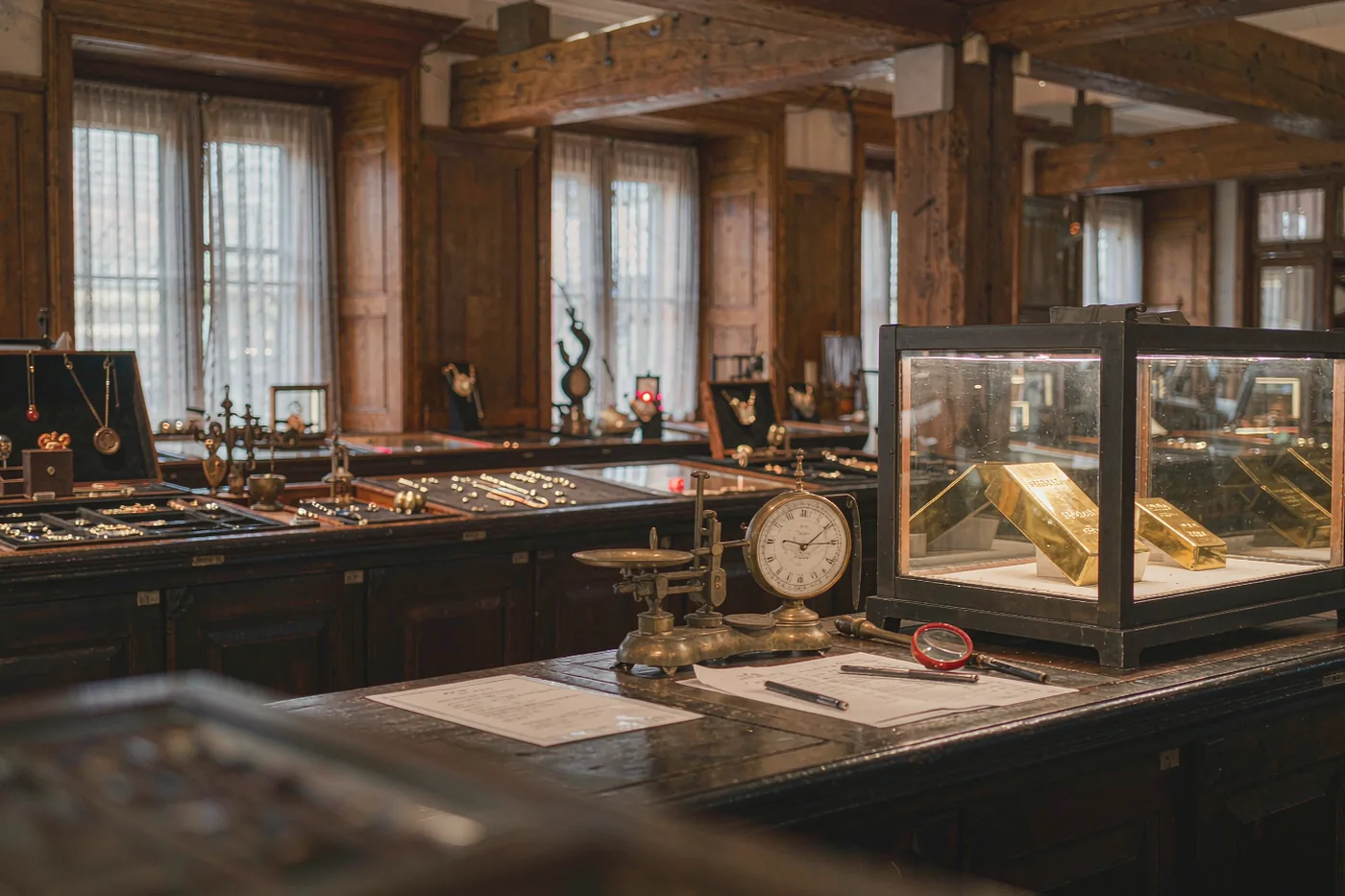
Licensed pawnshops sell appraised dead-pawn gold and watches; Caibai's flagship prices jewelry by the live gram. How both work with a passport — and where rates beat the airport.
Gold is having a moment in Beijing — and two institutions most visitors never think about can make it part of your trip for the right reasons. Licensed pawnshops (典当行) sell unredeemed dead pawn (绝当) gold, watches and jewelry at a discount, and double as the fastest way to turn a watch into same-day cash. Caibai (菜百首饰), the Shanghai-listed gold retailer whose flagship counter prices jewelry by the live gram, even runs a free gold-and-gem museum upstairs. This guide covers how both actually work with a foreign passport, what to check before you pay, and where the exchange rate off the airport floor is better.
A modern Chinese pawnshop is closer to a licensed lender plus a second-hand luxury dealer than the dusty stereotype. Three counters matter to travelers: pledge loans against gold, watches and luxury bags, with cash in hand within the hour; dead-pawn sales of items whose owners never returned; and appraisal of anything you are about to buy second-hand. The two big names in Beijing are Huaxia Pawn (华夏典当行), a national chain with 30 years of history, and Baoruitong (宝瑞通), founded in 1997 and among the city's largest with 20-odd branches. Both list the passport as an acceptable ID for international customers.
When a customer neither redeems nor renews a pledge by the deadline, the item becomes dead pawn and the shop sells it to recover the loan. Under the national pawn rules, items appraised at ¥30,000 or less may be sold directly by the shop, so counter stock turns over constantly [verify]. Pricing is anchored to the appraisal value, which is why a dead-pawn gold chain can land noticeably under the same-weight retail price — the discount is smaller than at a pure reseller, but the piece has been through in-house appraisers trained in the national gem-testing system. Stock is one-of-one and moves fast, so call the branch before making a special trip.
Caibai is the retailer Beijing prices against: a Shanghai Stock Exchange listing (605599), a member of the Shanghai Gold Exchange, and a licensed China Gold Coin retailer that sells panda coins. The flagship at 306 Guang'anmennei Dajie (广安门内大街306号) is a four-floor emporium — 1F gold jewelry, platinum and investment bars; 2F diamonds and colored gems; 3F jade and the trade-in service; 4F amber and 18K. It also houses the free Beijing Caibai Gold and Jewelry Museum, a registered museum whose mineral specimens and amber are worth 30 minutes of any gold trip. Hours run roughly 9:30–20:30 [verify]; phone 010-83520088. Take Line 7 to Guang'anmennei station and walk about 100 m east.
Every price on the wall starts from the live base gold price (基础金价), which tracks the Shanghai Gold Exchange and is reposted daily. On top of that sit the brand premium and the craft fee (工费). On 2026-11-18, jewelry gold at Caibai quoted around ¥1,158 per gram against an investment base price of about ¥816 — the roughly ¥340 gap is artistry, not metal [verify; prices move daily]. Jewelry bars (饰品金条) sat near ¥1,010, while plain investment bars track the base price far more closely. The wider the gap against the base price, the more you are paying for craft: fine for a bracelet you will wear, poor value if you think of it as bullion.
A passport is accepted at Caibai and other major retailers for jewelry and bars, exactly as for any other purchase [verify for very large bars]. Foreign cards and Alipay work like any retail counter, subject to the daily spending caps covered in our payment guides. Keep every invoice: customs can ask for proof of purchase when you carry gold out, and the old Gold and Silver Administration rules still put paperwork requirements on bulk gold exports [verify]. Reasonable personal jewelry with a receipt clears outbound customs without issue; several bars or coins in original packaging are a gray area best declared.
The airport floor gives the worst rate of any legal counter; city-center bank branches sit closest to the official mid-rate; hotel desks vary wildly. For converting CNY back to your own currency, remember the rule covered in our money guide: banks redeem CNY against the original exchange memo (兑换水单) within 24 months, so keep it. Never treat a pawnshop as a money changer — they are not licensed for currency business [verify], and no legitimate pawnshop will exchange your dollars. For ATM fallback and declined-card triage see our cash-plan guide; for setup steps see money-in-china.
If you need cash for the last two days of a trip, a pledge beats a distressed sale: Huaxia and Baoruitong appraise a watch or gold chain on the spot and lend against it, redeemable when you return. The cost runs about a 4.2% monthly comprehensive fee plus 0.5% interest — roughly 4.7% per month for civil items — so it only makes sense for days-scale borrowing [verify]. Bring your passport; the flow is ID check, appraisal, a pawn ticket (当票), cash. Miss the redemption window and your item becomes dead pawn — exactly the supply that feeds the bargain counter.