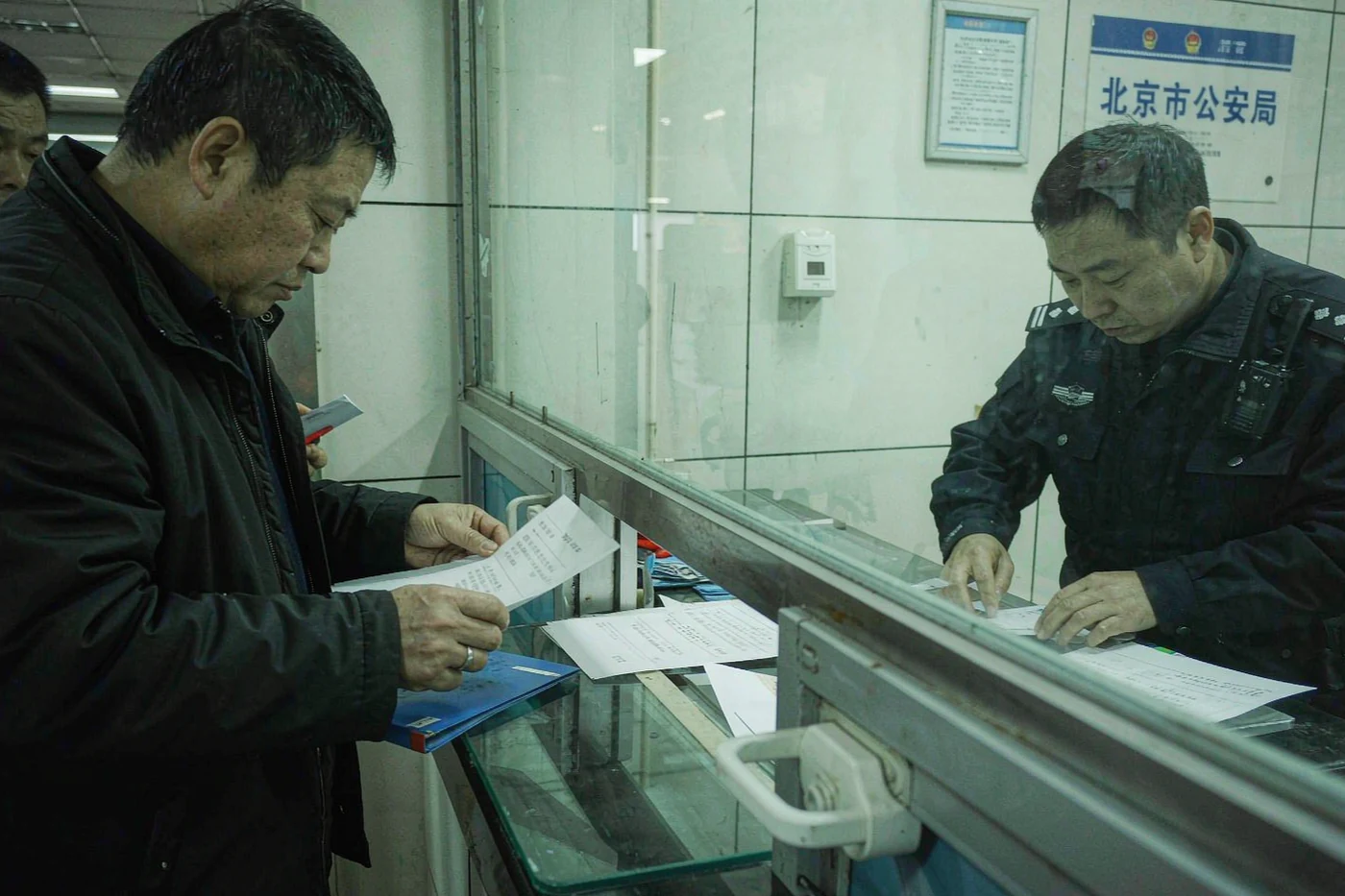
Two documents, two offices: how to get a police report receipt (受案回执) in Beijing, how long-stay foreigners apply for a no-criminal-record certificate (无犯罪记录证明), and how to make it valid abroad.
Two documents trip up long-stay foreigners in Beijing more than almost any other piece of paperwork, and they come from two different offices that will each send you to the other if you ask for the wrong one. The first is the 受案回执 (shòu'àn huízhí) — the case-acceptance receipt you are handed after reporting a theft, an assault, a scam or damage to the police. The second is the 无犯罪记录证明 (wú fànzuì jìlù zhèngmíng) — the certificate of no criminal record that a work permit, a residence permit or a visa application back home will ask for. The local police station (派出所, pàichūsuǒ) issues the first; the exit-entry administration office (出入境管理部门) issues the second. This guide covers both: which one you actually need, what to carry, how long it takes, and how to turn a Chinese-only certificate into something an authority overseas will accept.
The names get translated loosely in embassy emails and insurance portals, so match the document to the person asking for it rather than to the English word they used.
For anything in progress — a theft you have just noticed, an injury, a threat — call 110. The dispatcher speaks Chinese and will ask where you are, what happened and your phone number, in roughly that order. If you cannot make yourself understood, Beijing's 12345 city services hotline has English-speaking operators around the clock and can bridge a three-way call with an interpreter. For a report with no urgency — a scam that already happened, a phone taken hours ago, damage you discovered later — go in person to the police station (派出所) for the district where it happened, not the one nearest your hotel. Carry your passport: the station will not take a report without an identity document.
This is the part most visitors do not know, and it is the difference between holding proof and holding a memory. Under the Ministry of Public Security's rules on handling administrative cases, a police station that accepts a report must register it, and where the case falls inside its own jurisdiction it must produce a case-acceptance record and hand the 受案回执 to the person reporting. The rules on receiving reports add a 'three on-the-spot' standard: register the report on the spot, accept the evidence on the spot, and issue the receipt on the spot. If you hand over evidence — a phone, a receipt, screenshots — ask for the 接受证据清单 (evidence acceptance list) too; the rules require it. Two things to understand about the receipt itself: it proves that you reported, not that a crime occurred, and it is not the same document as a decision to open a formal case (立案). Insurers and embassies almost always want the former, not the latter. Photograph the receipt the moment you get it — it is one sheet of paper, and replacing it means going back to the station that issued it.
Neighbourhood stations are busy and mostly Chinese-speaking. Turning up with the following turns a two-hour uncertain visit into a twenty-minute one.
The 无犯罪记录证明 is not issued by your neighbourhood police station for individual applicants — it is handled by the exit-entry administration department of the public security bureau at district level or above, in your place of residence. Beijing's public security bureau states the threshold directly: foreigners who have accumulated 180 days or more of residence may apply, at any district exit-entry office in the city or online through the Beijing PSB web portal. The residence that counts is either the place that issued your permit or anywhere you have actually lived for 180 days or more, so a long-stay resident who moved between cities can usually apply in the last one. Note that Beijing's own answer frames the threshold as 180 days accumulated in Beijing (在京累计居留180天(含)以上), while the city's English portal describes it as 180 days in China — confirm which reading your office applies. [verify]
Fill in the 查询申请表 (inquiry application form) and bring your valid passport or foreign permanent residence card. If someone applies on your behalf, they need a power of attorney plus their own original ID. If you apply more than three times in a single calendar year, Beijing asks for material showing the certificate is for a legitimate purpose — an employer letter or an immigration checklist is normally enough. There are two channels. In person: take the application to a district exit-entry service centre and collect the paper result from the same office. Online: the Beijing PSB site (gaj.beijing.gov.cn) under government services → I want to apply → exit-entry → criminal record inquiry for foreigners, where the result is issued as an electronic version. District halls listed on the Beijing government portal include the Dongcheng centre at Window 26, Dongcheng District Government Service Center, 12 Zhushikou East Street (Monday to Friday, 9:00–17:00, 010-84081083), and the Chaoyang centre at 1–2F, Building 304, BEZ IT Park, 10 Jiuxianqiao North Road (9:00–17:00, Monday to Saturday). Windows and hours change — check before you travel. [verify] Municipal service pages in several Chinese cities list the criminal-record inquiry as free of charge. [verify]
The certificate comes out in Chinese and is not, on its own, enough for most foreign authorities. The standard chain is three steps. Translation first: a certified translation agency, or the translation desk attached to a notary office, produces a Chinese–English version. Notarisation second: a Beijing notary office with foreign-affairs (涉外) authority binds the translation to the original and issues a 公证书. Legalisation third — and this changed recently: since 7 November 2023 China has been a party to the Hague Apostille Convention, so a document going to another member country needs only an 附加证明书 (Apostille) from the Ministry of Foreign Affairs or an authorised provincial foreign affairs office, instead of the old two-step consular legalisation. A document going to a non-member country still takes the old route: consular authentication, single or double. Issued apostilles can be checked online at consular.mfa.gov.cn/VERIFY/.
Four failure modes account for almost every stalled application.