Your phone is your wallet, metro pass and map in Beijing, so a dead battery stops everything. How shared power bank rental works for foreign visitors: scanning with Alipay or WeChat, real hourly prices and daily caps, the same-brand return rule, and how to fight a wrongful charge.
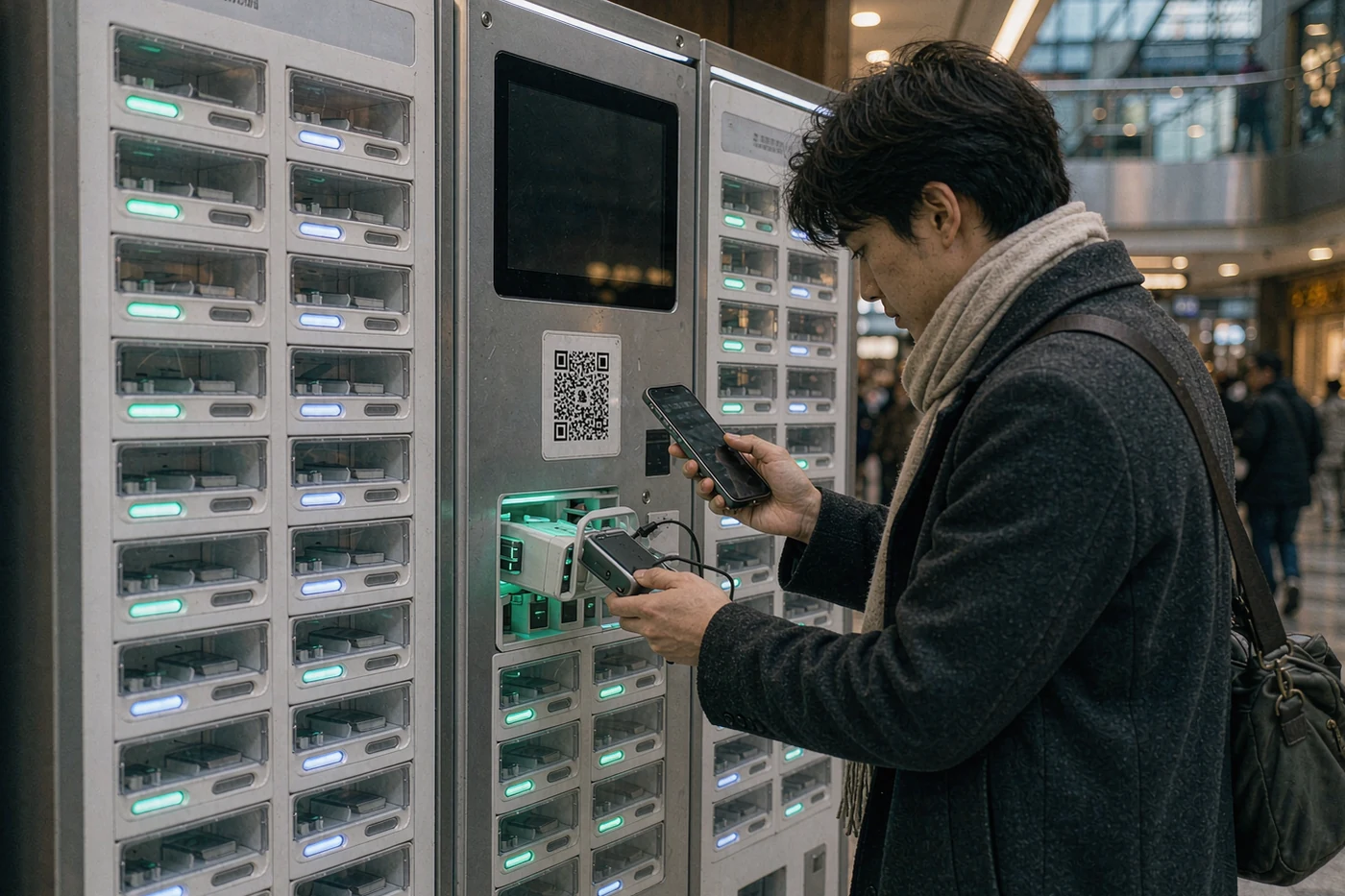
In Beijing your phone is your wallet, metro pass, translation app, map and boarding pass all at once — and when it hits 5% in the middle of a hutong, everything stops at the same time. The city's answer is the shared power bank (共享充电宝): small rented batteries dispensed from cabinets in malls, restaurants, convenience stores, hotels and subway station halls. Scan a code, a charged bank pops out with its own cables, and you return it to any cabinet run by the same brand when you are done. Rental is cheap, the network is dense, and the whole flow runs inside WeChat or Alipay — but the return side has real traps that can turn a ¥6 rental into a ¥99 charge. Here is how it works and how to avoid every one of them.
Almost every cabinet in Beijing belongs to one of a handful of national networks, and they work nearly identically. What matters for you is the logo on the cabinet: it decides which app the QR code opens and — crucially — which cabinets will accept the bank back.
The whole flow happens inside your payment app — the cabinet's own screen is Chinese-only, but you barely need to read it.
Prices jumped in 2025–2026, so ignore older blog numbers. In ordinary central locations expect roughly ¥3–6 per hour [verify], billed by the half hour or hour; at airports, railway stations, scenic areas and bar streets the same brand can charge ¥8–10 per hour [verify]. The first 1–3 minutes are usually free — enough to test a dead slot and re-dock. Every network applies a daily cap, typically ¥30–50 per 24 hours [verify], and an absolute cap of ¥99 [verify] — hit that and you have effectively bought the bank. Two subtleties: pricing is set per merchant, so two cabinets 50 metres apart in the same mall can charge different rates, and the differences run between shops of the same brand, not just between brands.
Slots are physically brand-specific — a Meituan bank will not lock into an Energy Monster cabinet, and pushing it into a rival rack accomplishes nothing except wasting your time. Take a photo of the cabinet (logo visible) when you rent, and use the mini-program's nearby-stations map to find return points when you are done. The network is citywide and nationwide: consumer-group testing for Jiangsu's provincial consumer council found banks rented in smaller cities returned in Nanjing smoothly, with no cross-city surcharge.
Billing stops when the bank clicks into a slot AND the mini-program confirms the order is completed. A badly seated bank, a dirty contact or an offline cabinet will keep metering quietly — the accidental path to a ¥99 charge two days later. After you dock, stand there for about a minute and watch for the return-successful notification with the final amount. No notification means you are still renting. This one habit prevents almost every power-bank horror story.
Both strategies work, and experienced travelers do both. Renting wins around town: zero weight in your day pack, no airport rules to worry about, and cabinets dense enough in central Beijing that you are never far from one. Carrying your own wins everywhere the network thins out — long train rides, the Great Wall, big parks, early-morning starts. If you fly in with your own bank, it must travel in cabin baggage (never checked), stay within airline capacity limits, and carry a legible label; units bought in China need the CCC mark — our domestic flight power-bank guide covers the details. A middle path for a week-long stay: buy a fresh ¥50–100 bank [verify] at a Xiaomi store or convenience store on day one, and you will likely break even against rentals before flying home with it in your carry-on.
Central malls and dining streets are saturated, but three situations catch visitors out. First, hutongs and older neighborhoods: cabinets exist near the main streets but vanish as you go deeper — exactly where your GPS and translation app are working hardest. Second, closing time: a cabinet inside a mall, restaurant or KTV goes unreachable when the venue shuts, usually around 22:00, so plan your last return somewhere that stays open. Third, departure day: return the bank before security at the railway station or airport. You can physically travel with a rented bank, but it will keep metering in your bag until it hits the cap, and the mini-program will not remind you.
A four-hour rental at downtown rates runs about ¥12–24 [verify] — less than any café would charge you for the seat and socket. A full day out often lands near the daily cap of ¥30–50 [verify]. If your itinerary is one long day at the Great Wall plus museum days in the city, rent; if you are in Beijing for a week with heavy navigation and photography, a bought bank pays for itself by day three or four. The system's real value is structural: in a city where paying, boarding and translating all run through one battery-hungry screen, a shared power bank network is basic infrastructure — and it is one of the few conveniences here that works exactly as smoothly for a foreign card as for a local one.