Explore Beijing / Beijing SIM Cards for Foreigners: Airport Counters vs City Carrier Stores
Beijing SIM Cards for Foreigners: Airport Counters vs City Carrier Stores
Where Beijing's carrier counters actually are, how passport registration works, what plans cost, and how to replace a lost or cracked SIM — the store-level guide.
9 min read · KOULING's Beijing Travel Guide
Most Beijing arrival guides stop at "buy a SIM at the airport." But somewhere between the arrivals hall and day three, things get more specific: the tourist card runs out of data, the SIM cracks, you want a cheaper monthly plan, or a store asks you to come back with your passport. This guide is the practical layer underneath that moment — how China Mobile, China Unicom and China Telecom actually register a foreign passport, which counter to walk into in Beijing, what the process costs, and how the airport option differs from a city carrier store (营业厅). If you are still deciding between a travel eSIM and a local number, read our eSIM comparison first; this article starts once you have decided you need a physical Chinese SIM.
Two doors, one legal requirement
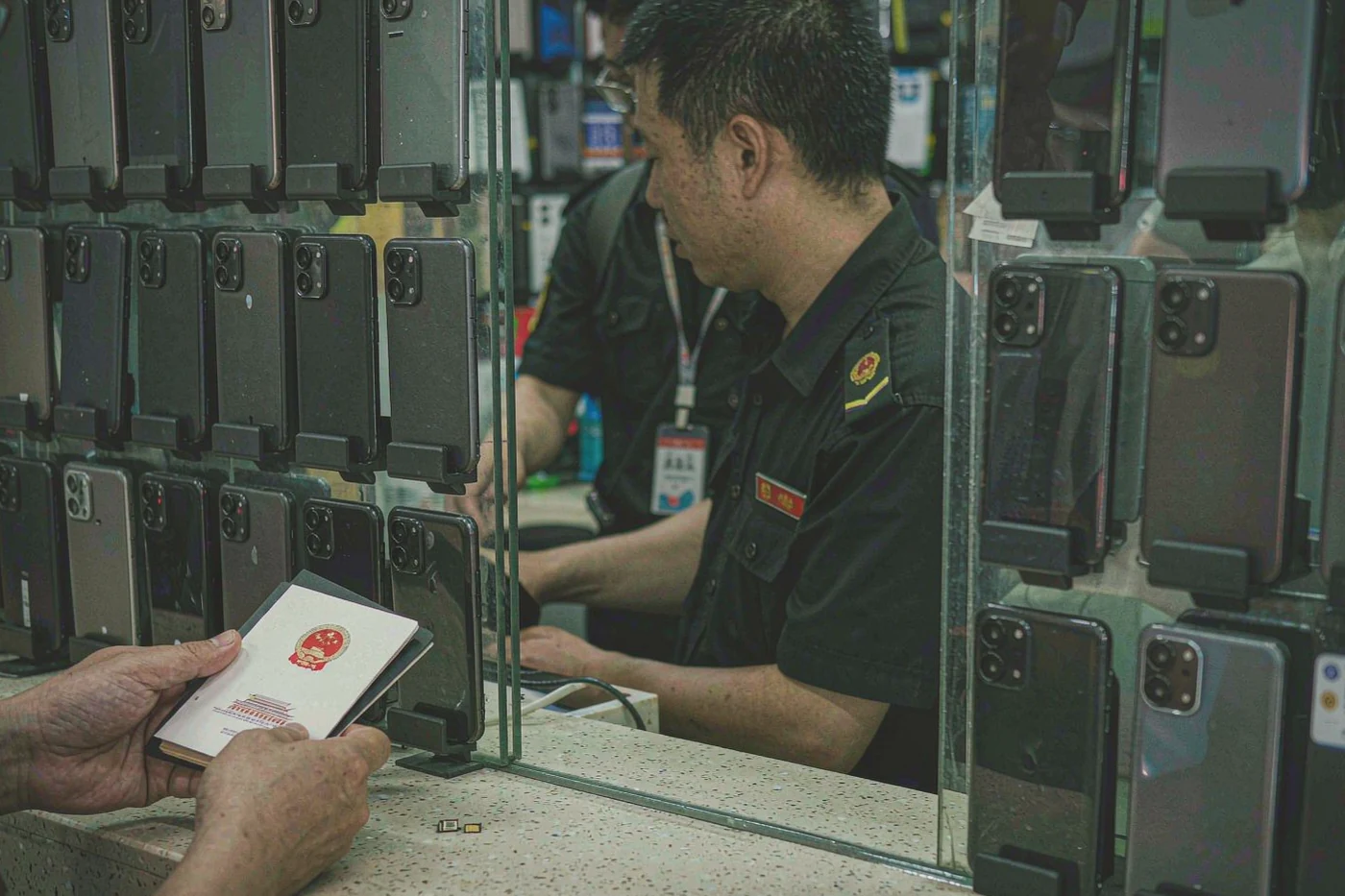
China runs real-name registration for every SIM card, and for foreign passports that means one thing: the registration happens face-to-face. Staff scan your passport, take your photo for the face check, and activate the card on the spot — it cannot be done by email, by a friend holding your passport, or by most third-party phone shops. Regulators are explicit that a foreign national must apply in person at a carrier's self-operated store (自办营业厅) or an official airport counter. That is the constraint everything else in this guide works around.
Airport counters — purpose-built for arrivals: English-capable staff, short-term tourist cards, foreign card and cash payment, 5–10 minutes door to signal.
City carrier stores (营业厅) — the full menu: monthly plans, SIM replacement, plan changes, suspension, broadband bundles — but you navigate there yourself and smaller branches may be slower with passports.
Airport counters: where they actually are in Beijing
Beijing Mobile, Unicom and Telecom all staff counters in the international arrivals areas, but the exact corners matter when you are dragging a suitcase. The Beijing Mobile points are the most documented. Hours and locations do shift with terminal renovations — treat the list below as reliable as of late 2026 and reconfirm with the hotline if you land late at night.
Capital Airport (PEK) Terminal 3 — China Mobile — Level 2, international arrivals, opposite carousel 38; daily 9:00–18:00 [verify].
Capital Airport (PEK) Terminal 2 — China Mobile — Level 1, inside Gate 7; daily 9:00–18:00 [verify].
Daxing Airport (PKX) — China Mobile — Level 3 domestic departures hall; 9:00–19:00 [verify].
Unicom and Telecom points — Unicom staffs a desk at PEK T3 Level 2 near Exit B and at Daxing's international arrivals exit [verify]; Telecom coverage rotates — if you cannot find one, the 24-hour "Beijing Service" desk opposite Daxing's international arrivals will walk you through SIM options in 5–10 minutes.
Late landing? — Hours above close by early evening. If you arrive after that, the 24-hour Beijing Service point at Daxing or an eSIM activated before your flight is the fallback.
What to bring, and the in-person rule
The process itself is quick, but only if you arrive with the right things. Staff cannot bend the identity rules for you, and the most common reason a visitor gets turned away from a small phone shop is exactly the rule below.
Your passport, original — scanned, photographed and matched to you in person. Copies and photos on your phone do not count; nobody may apply on your behalf.
An unlocked phone on 5G or VoLTE — regulator guidance says devices must support 5G or VoLTE; most phones from the last five years do. If yours does not, the store can advise on a swap.
Payment that works on day one — airport-area Mobile halls take foreign cards (Visa/Mastercard), cash, Alipay, WeChat Pay and e-CNY. City stores are usually cash- or domestic-app-first — carry cash.
A local address — your hotel name and district is fine; some registration forms ask for one.
The counter procedure, minute by minute
Budget 15–30 minutes including queueing at an airport counter, less at a quiet city hall. The steps are identical everywhere because the real-name system is identical everywhere.
Say what you want — "我要办一张手机卡" or just show your passport and say "foreigner SIM". Beijing Mobile's 200+ halls run translation software, and its flagship foreigner-service halls have bilingual signage and English-speaking staff.
Identity check — passport scanned, your photo taken on the spot for the face-match, details entered into the system. This is the step that makes remote or proxy applications impossible.
Pick a number and a plan — you can usually choose from a screen of available numbers. Take a photo of the plan sheet before deciding — prices differ between short-term and monthly lines.
Activate and test before you leave — confirm signal bars, send a text, load a webpage on mobile data, and write the new +86 number down. The number is the key that unlocks everything else — Didi, 12306, WeChat Pay verification — so treat it like a password.
Plans and realistic prices
Three product families matter to visitors, and the price gap between them is larger than most arrival-day buyers realize. All figures below move with promotions — confirm the current sheet at the counter.
Short-term tourist cards — Beijing Mobile's "Smart Card" (灵动卡) line comes in 7-, 10-, 15- and 30-day versions; the reported 10-day version runs about ¥120 for roughly 35 GB plus 150 minutes and an international-call discount quota [verify]. Unicom sells comparable 7/15/30-day tourist packs. The card auto-expires on its final day.
Standard monthly plans — roughly ¥50–100/month for 10–30 GB, ¥79–129 for 30–100 GB tiers [verify]. Better value than tourist cards beyond two weeks, and cancellable when you leave.
Long-stay contracts — 12-month plans from about ¥49–99/month [verify] — only sensible for study or work visas, and usually bundled with the same passport registration.
Auto-expiry warning — tourist cards cancel themselves on day 7/10/15/30. If you signed any app up with that number (WeChat, Didi, hotel Wi-Fi accounts), delete or re-bind those accounts before it expires — otherwise you lose the recovery path.
When the airport is the wrong door
The airport counter is optimized for one transaction: land, register, buy a short card, go. Walk past it — into a city 营业厅 — when your need is any of the following.
Wider plan selection — city halls carry the full monthly and long-term menus, not just the arrivals-hall tourist cards.
Anything touching an existing number — SIM replacement, plan changes, suspension (停机保号), cancelling a contract, broadband bundles — city self-operated halls only.
English-capable flagship halls — Beijing Unicom runs three foreign-affairs halls in the embassy districts; the Tayuan (塔园) hall in the second embassy district is its international service flagship, with English-speaking staff and free passport-photo printing. Beijing Mobile designates foreigner-service halls such as Wangjing and Dongzhongjie. A quick call to 10086 / 10010 / 10000 gets you the nearest one [verify locations before setting off].
The 5-and-10 card limits — one person may hold at most 5 active cards per carrier nationwide; once your industry-wide total hits 10, further cards can only be issued at a self-operated hall counter. Relevant if you collect numbers across trips.
Cracked, lost or dead SIM: the replacement path
A SIM card is a €1 piece of plastic wrapped around your entire Chinese digital life — when it fails, everything from Didi to hotel bookings stalls. The fix is mechanical and fast if you do it right. (This is about the card itself; if the whole phone is gone, our lost property guide covers tracking, police reports and Didi's item-return channel first.)
Go to a self-operated hall, in person — replacement (补卡 for lost/damaged, 换卡 for a working card swap) requires the registered owner with the original passport — the same in-person rule as day one.
Cost and speed — carrier fee notices typically list ¥10–20 per SIM [verify]; many carriers waive the first replacement or reward long-tenure customers with free swaps. Done in minutes, same number, instant completion.
What you lose — the old card dies when the new one activates. Contacts stored on the SIM (rare now) go with it; app accounts tied to the number survive because the number survives.
Suspend instead of cancel — leaving China for a few months and want to keep the number? Ask the hall about suspension (停机保号) — rules and monthly hold fees vary by carrier and province, so get the current terms in writing before you fly.
A note on online channels in 2026
Two facts keep tripping up repeat visitors. First, since August 2026 China Mobile has restricted internet-channel SIM sales to its official app and website — third-party platforms no longer sell its number cards [verify]. Second, online ordering still does not replace the face-to-face step: identity verification for foreign passports ends at a counter. Beijing Mobile does offer a useful hybrid — scan a QR code to pre-book, choose your number and plan, upload your passport — then finish the face check and activation in the hall, which trims counter time. Plan for the store visit either way.
Before you queue
Go to the right kind of store — carrier-branded self-operated halls and official airport counters only. Small phone shops and electronics malls usually cannot register foreign passports and will send you across the street.
Test before you pay-and-leave — signal, SMS, mobile data, one verification-code SMS if possible. Problems found at the counter take two minutes; problems found at your hotel take a second trip.
Keep the plan sheet — photograph the tariff table with the store's name on it. When a charge puzzles you later, that photo is your evidence.
Dial the hotline for anything unusual — China Mobile 10086, Unicom 10010, Telecom 10000 (+86 from abroad). Foreign-passport questions are common enough that all three have standard answers for them.
Mind the calendar on tourist cards — note the auto-expiry date the day you buy. A tourist card that quietly lapses mid-trip looks identical to a network problem and wastes an hour of debugging.