Explore Beijing / Beijing's Wet Markets at Chinese New Year: What Vendors Sell Before the Shutdown and When Everything Closes
Beijing's Wet Markets at Chinese New Year: What Vendors Sell Before the Shutdown and When Everything Closes
Beijing's wet markets transform in the week before Chinese New Year — then go quiet. Here's what to buy, what to expect, and when stalls shut down.
5 min read · KOULING's Beijing Travel Guide
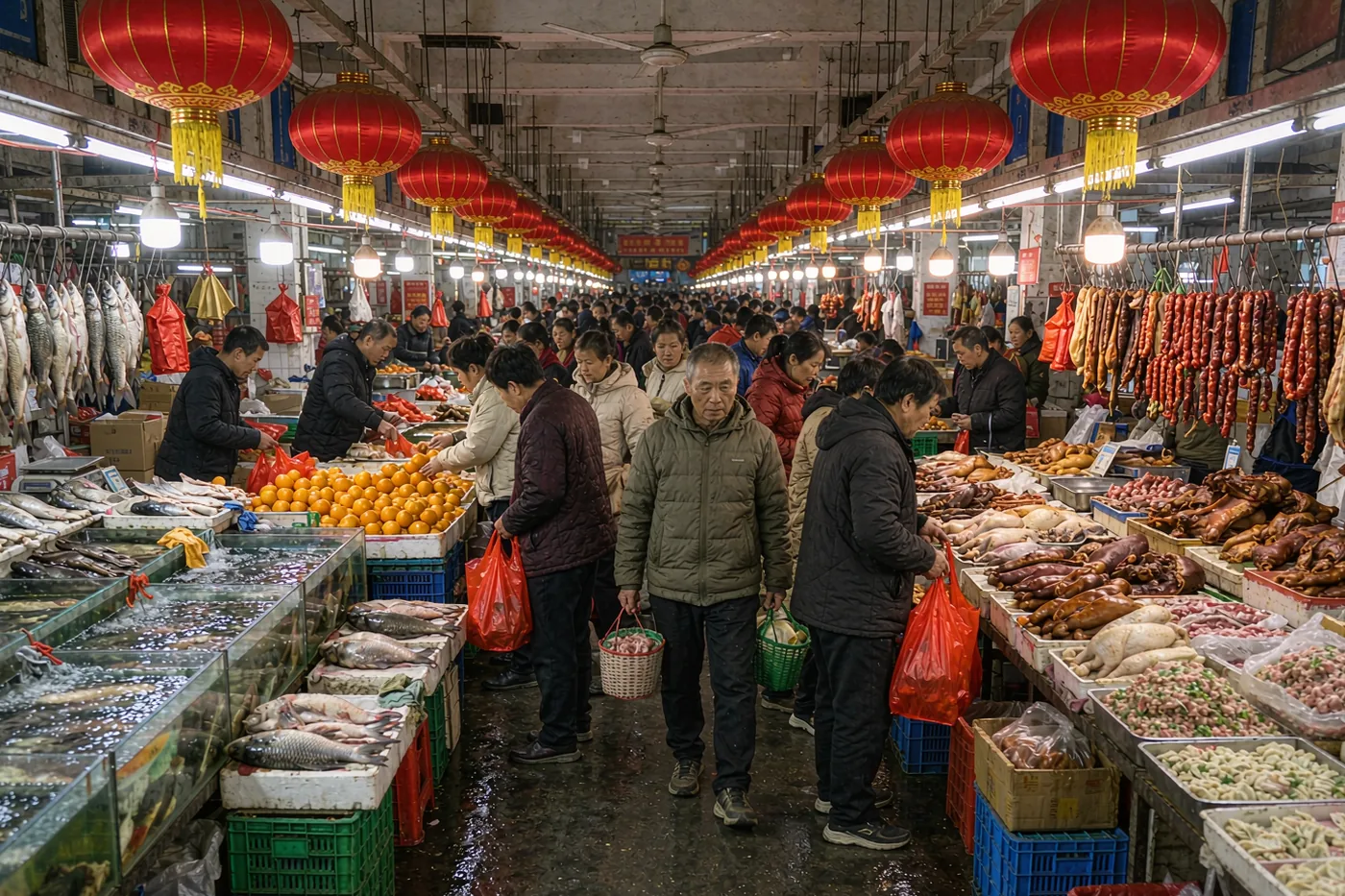
If you time it right, the week before Chinese New Year is the most atmospheric moment of the year to visit a Beijing wet market. Stalls overflow with live fish, whole chickens, cured sausages, boxes of oranges, and bags of dumpling filling. Then, typically from New Year's Eve through the first few days of the holiday, many independent vendors simply go home to their families — and the market goes quiet. For a first-time visitor, this is one of Beijing's most honest cultural experiences, but it takes planning. Note that exact closure dates shift every year with the lunar calendar [verify before travel].
What Vendors Sell in the Final Week
The days before New Year's Eve are peak trading season. Expect crowded aisles, cash changing hands fast, and vendors working from dawn. Prices for fish, meat, and fresh produce often rise 10–30% in the final days [verify before travel]. You'll see:
Live fish and seafood — Carp ('nian nian you yu' — a pun on yearly abundance) is the star. Tanks stay busiest until the last afternoon before the holiday.
Cured meats and sausages — La rou (cured pork) and lacquered duck hang in bundles — classic New Year provisions.
Dumpling supplies — Chives, cabbage, pork mince, and wheat flour sell by the sack. Families make dumplings together on New Year's Eve.
Symbolic produce — Boxes of mandarin oranges, red dates, and whole fish bought for display rather than eating.
When Everything Closes — and Reopens
Most independent wet market vendors are small family businesses. Commonly, stalls wind down on the afternoon of New Year's Eve, and the market is largely empty for the first 3–7 days of the holiday. Some large chain supermarkets inside or near the market buildings stay open with reduced hours, but fresh-fish tanks and butcher stalls are usually shut. Reopening is staggered: some return on the 5th or 6th day of the new year, many after the full holiday week, and the market is usually back to full bustle by the Lantern Festival (the 15th day) [verify before travel — exact dates depend on the lunar calendar each year].
Practical Tips for Visiting During CNY
Go in the morning, early — The final pre-holiday days sell out fast. Arrive before 9:00 AM for the best selection [verify before travel].
Bring small cash — Most locals pay by WeChat or Alipay, which need a Chinese bank card or a linked international card via the apps' international versions. Keep ¥50–100 (about US$7–14) in small notes as backup [verify before travel].
Expect crowds, not English — Pointing and showing a phone translation works. Be patient — vendors are rushed and polite exchanges go a long way.
Don't count on eating there — Small eateries inside markets often close with the stalls. Nearby restaurant chains and hotel restaurants are more reliable during the holiday.
Watch the freeze — In January–February Beijing can be –5 to –10°C (23–14°F). Bring a warm layer; market aisles are often unheated.
Sanyuanli Market (Sanyuanli Nongmao Shichang)
Beijing's best-known wholesale-to-retail market, northeast of the city centre. It's enormous — fresh produce, live seafood, meat, and dried goods in separate zones — and at its most intense in the final week before the holiday. Expect near-empty aisles during the first days of the new year.
Metro
Reachable via metro; confirm the current line and nearest station before travel [verify before travel].
Opening hours
Roughly 6:00 AM–6:00 PM normally; many stalls close from New Year's Eve through the first days of the holiday [verify before travel].
Tickets
Free to enter.
How long
1–2 hours
Shengfuxiao Market (Shengfuxiao Shichang)
A mid-sized, very local market popular with expat cooks, with a good mix of fresh produce, bakeries, and imported-goods stalls. Foreign vendors and English-speaking regulars make it slightly easier for first-timers. Holiday closures here tend to be shorter than at wholesale markets, but the first two or three days of the new year are still quiet [verify before travel].
Metro
On the city's metro network; confirm the current line and station name [verify before travel].
Opening hours
Approximately 8:00 AM–6:00 PM; reduced holiday hours [verify before travel].
Tickets
Free to enter.
How long
1 hour
Huguosi Snack Street & Neighbourhood Markets
For atmosphere over shopping, the hutong areas around Xisi and Huguosi offer small neighbourhood markets plus traditional snack shops. Some snack shops historically keep at least partial holiday hours because of tourist demand, but don't rely on it — check locally [verify before travel].
Metro
Central location on the metro network; confirm the current line and station [verify before travel].
Opening hours
Snack shops vary, roughly 9:00 AM–8:00 PM; many close or reduce hours during CNY [verify before travel].
Tickets
Free to walk; snacks typically ¥5–30 (US$1–4) each.
How long
2–3 hours
A Pre-Holiday Market Day (e.g., 3 days before New Year's Eve)
08:30
Head to Sanyuanli MarketArrive early for the full pre-holiday frenzy — live fish, cured meats, and dumpling supplies at their peak.
11:00
Coffee and recoveryThe market is loud and crowded. A nearby café break lets you regroup; many chains stay open through the holiday [verify before travel].
13:30
Shengfuxiao Market for a slower browseSmaller and friendlier; pick up snacks, fruit, or gifts. Prices may be 10–20% higher than usual this week [verify before travel].
16:00
Hutong walk and dinnerWander the Xisi hutongs, then eat at a restaurant chain or hotel restaurant — small independent eateries may already be shutting for the holiday [verify before travel].