Ride China's high-speed trains hands-free: how to ship a suitcase from hotel to hotel with SF Express or JD Logistics, what it costs, and the traps that delay bags.
China's high-speed rail will get you from Beijing to Xi'an in under five hours, but no train was designed around a 28-inch suitcase. The workaround locals use is simple: hand the heavy bag to a courier the evening before, ride the train with a daypack, and collect the suitcase at your next hotel's front desk. Intercity door-to-door delivery costs about the price of a nice dinner, runs on one of the densest express networks on earth, and works for foreign visitors without a Chinese ID. This guide walks through the three realistic ways to set it up, what it costs, and the mistakes that get bags delayed.
The official limits are generous by airline standards but strict for big cases. Each adult ticket includes 20 kg of luggage; children get 10 kg and diplomatic passport holders 35 kg. On bullet trains (G, D and C services) a single piece may not exceed 130 cm in total dimensions - length plus width plus height. A typical 28 to 29 inch case sits right at or over that line, and the shelf space between cars is gone within minutes at a busy station. Standing in a packed aisle with a case wedged against your knees for five hours is exactly the experience shipping avoids.
There is no Japan-style national hotel-to-hotel forwarding network in China. What exists instead is a dense, cheap, next-day express network that any hotel front desk can plug your suitcase into. You have three options, and many travelers end up using a mix.
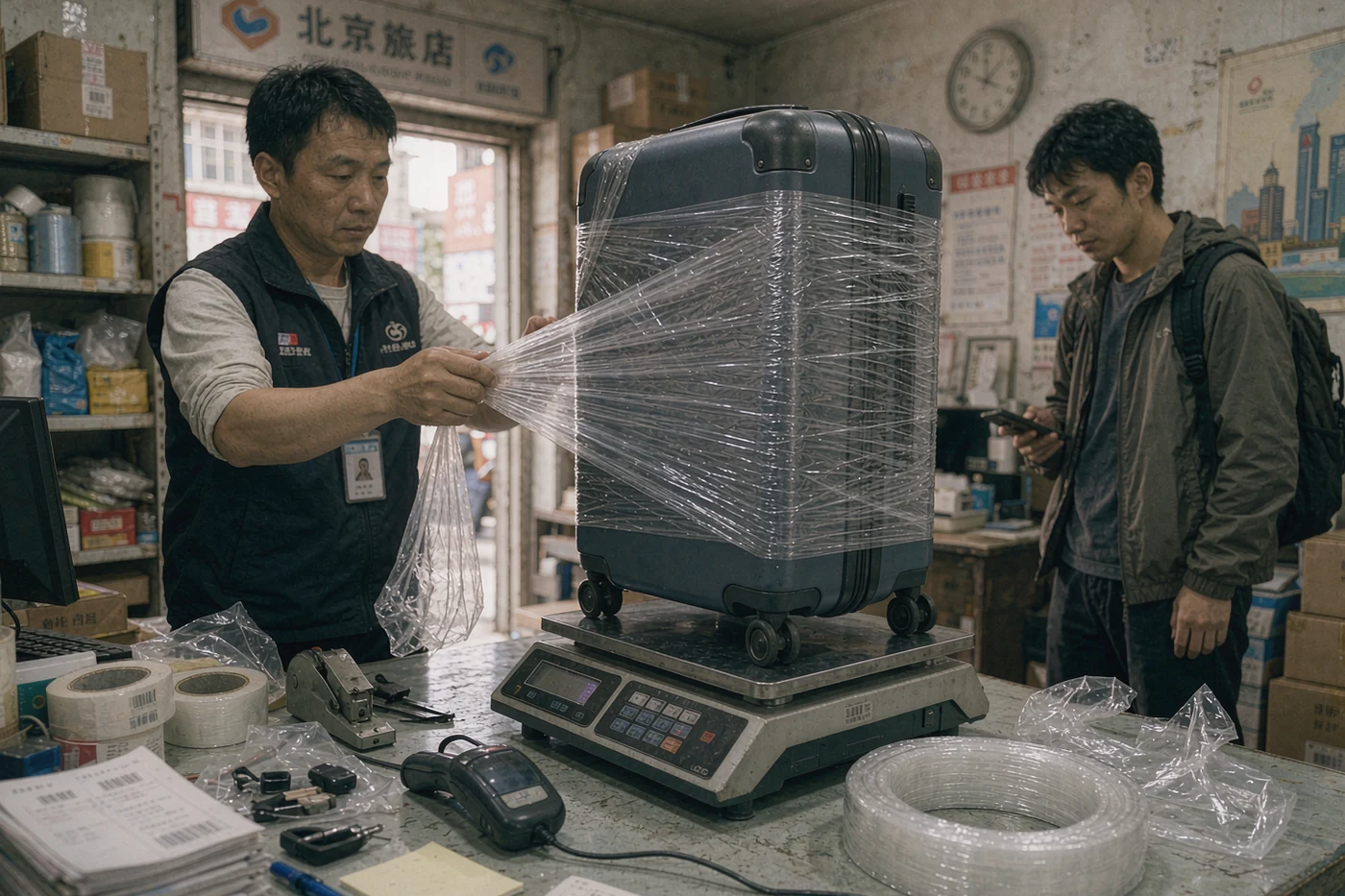
Chinese hotels send parcels every day, and front-desk staff are completely used to this request. Bring your packed bag to the lobby, say you want to send it to your next hotel by SF Express, and staff will usually book the pickup on the hotel's own account and let you pay them directly by Alipay or WeChat. This route sidesteps the two things that stall self-service booking: the waybill wants a local phone number, and the address fields expect Chinese characters.
If you want to control the pickup window and watch the tracking yourself, book inside the Alipay app: search SF Express in the mini-program search bar, set the interface to English, and tap Send Parcel. Addresses paste in Chinese far more reliably than pinyin, so copy the destination hotel's address from its listing on a booking site or a map app before you start.
Since January 2026 the railway's 轻装行 porter service covers 111 stations - essentially every provincial capital. It is not an intercity courier: it only moves bags within 35 km of your departure or arrival station. Door-to-station or station-to-door costs 68 yuan per piece, and a platform-to-platform handoff costs 98 yuan. Book in the 12306 app between 48 and 4 hours before departure on the outbound side, or 24 to 1 hours before arrival on the inbound side; porters deliver within five hours of pickup. The hotline is 95572. Used at both ends of a train trip, it removes every heavy lift a courier does not cover. Prices were set for the pilot phase and may be adjusted [verify].
Express pricing is by billable weight, and intercity rates are far below Western courier prices. Typical door-to-door figures for one large case [verify]:
Couriers charge the greater of actual weight and volumetric weight, calculated as length times width times height in centimetres divided by 6000 (some carriers divide by 5000) [verify]. A big-but-empty suitcase or a bag of duvets can be billed far above its scale weight - travelers have shipped an empty 8 kg case and been charged for 15 kg. Compress soft items, and if you are forwarding an empty case, ask for the billable weight before you agree to the pickup.
Express parcels move partly by air, so the prohibited list is airport-grade. Power banks, spare lithium batteries and lighters are rejected at the X-ray stage, and a bag containing one stalls in the network. Anything you could not take through domestic airport security, keep with you.
The most common failure is a parcel arriving at a hotel that was never told to expect it. Message the next hotel a day or two ahead through your booking platform or WeChat: give your arrival date, your passport name, and say a suitcase is coming by SF Express - ask them to hold it. Hotels that take foreign guests handle this routinely, but front desks will not sign for an unnamed parcel they cannot match to a guest. Confirm the paying side too: you can prepay in-app, or use pay-on-delivery 到付, where the receiving hotel pays the courier and adds the fee to your room bill [verify].